
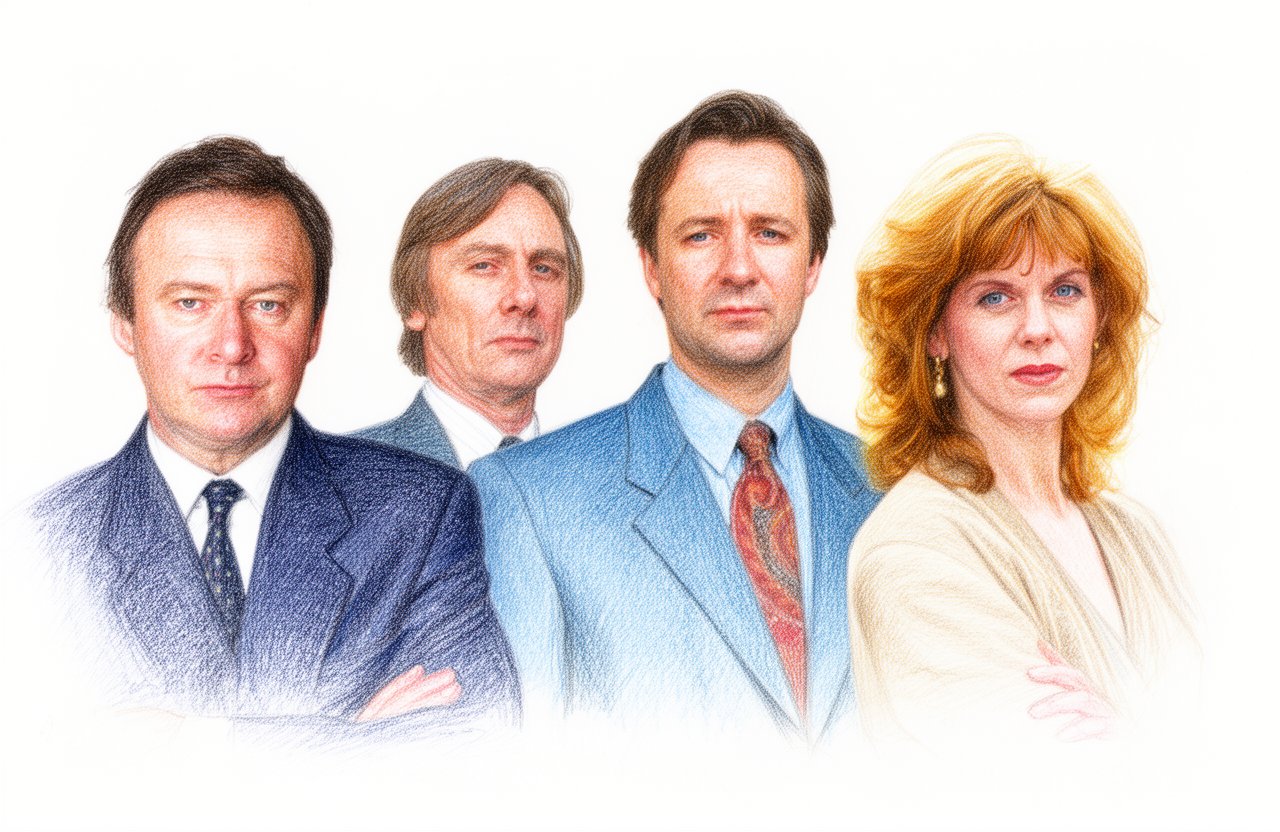
My Critique of Between The Lines
Between the Lines redefined the British police procedural by turning the gaze inward, examining the Complaints Investigation Bureau’s pursuit of institutional corruption rather than street-level crime. Its methodical narratives and moral ambiguity, epitomized by Tony Clark’s conflicted leadership, were bolstered by outstanding performances.
Yet the series’ drift into espionage and a notorious unresolved finale often felt like indulgence, straining credibility and closing on a note of nihilism. Amid the era’s cop dramas, it stood apart for exposing the architecture of power over individual misconduct.
For modern audiences, its forensic portrait of unaccountable systems remains bracingly relevant, even if its structural daring occasionally eclipsed coherence.
Principal Characters & Performances
Detective Superintendent Tony Clark
Neil Pearson brings a compelling, weary intelligence to Tony Clark, the moral compass at the show’s stormy centre. He begins as a rising star in the Metropolitan Police, only to have his career abruptly rerouted into the Complaints Investigation Bureau.
This internal affairs role isolates him, forcing him to investigate the very colleagues he once worked alongside. Pearson masterfully portrays Clark’s internal conflict, a man driven by a fundamental belief in justice yet increasingly disillusioned by the corruption he uncovers.
His performance is grounded in a quiet, dogged persistence. Clark is not a flashy action hero but a procedural investigator, using paperwork, interviews, and relentless pressure to break cases.
This is balanced by a messy personal life, notably his affair with WPC Jenny Dean, played by Lesley Vickerage. Pearson makes Clark’s guilt, grief, and growing isolation palpable, charting his journey from an institutional insider to a man utterly compromised by the truths he unearths.
Detective Inspector Harry Naylor
As portrayed by Tom Georgeson, Harry Naylor is the earthy, pragmatic counterweight to Clark’s idealistic strain. A veteran of the Complaints Investigation Bureau, Naylor operates with a cynical, world-weary understanding of how the police force truly functions.
He is initially sceptical of Clark, viewing him as a careerist interloper, but their relationship evolves into a grudging, then steadfast, partnership. Georgeson imbues Naylor with a dry wit and a street-smart intuition that proves invaluable.
His methods are often unorthodox, bending rules where Clark might hesitate, but his loyalty, once earned, is absolute. Naylor represents the show’s gritty realism, a man who has seen the worst of the job and has adapted to survive within its flawed machinery without completely losing his soul.
Detective Sergeant Maureen “Mo” Connell & Chief Superintendent John Deakin
Siobhan Redmond‘s performance as DS Maureen Connell was groundbreaking. As a bisexual detective, her character’s sexuality was presented as a matter-of-fact component of her identity, not a sensationalised plot device.
Redmond plays Mo as sharp, capable, and fiercely private, navigating workplace dynamics with a cool professionalism that masks a complex personal life. Her character provides a crucial third perspective within the core investigative team.
Tony Doyle is equally formidable as Chief Superintendent John Deakin, Clark’s superior. Doyle crafts a masterclass in ambiguous authority.
Deakin is a political operator, often obstructing investigations under the guise of protecting the force’s reputation. His motives remain tantalisingly opaque, leaving Clark and the audience to question whether he is a corrupt figure protecting his own or a realist managing impossible damage.
This tension between Deakin and Clark forms a central, gripping power struggle throughout the series.
Key Episodes & Defining Stories
Episode 1
The series premiere is essential viewing for establishing the show’s unique DNA. It immediately subverts the traditional police drama by making its hero, Tony Clark, an investigator of his own colleagues.
We see his promising career derailed into the politically toxic Complaints Investigation Bureau, a move that instantly isolates him. The locked office door and suspicious glances from former friends perfectly set the paranoid tone.
This episode introduces the core dynamic between Clark, the cynical Harry Naylor, and the perceptive Maureen Connell. It also seeds Clark’s fraught personal life with WPC Jenny Dean.
Fans remember it for its bold premise, establishing that the real criminals might be wearing the same uniform, a theme that would define the entire run.
Nobody’s Fireproof
This episode from the first series is a masterclass in building a corruption case from the ground up. When a superintendent is caught with a prostitute, Clark’s investigation peels back layers to reveal ties to a pornography magnate and financial malfeasance.
It showcases the show’s procedural strength, following the meticulous, often frustrating work of internal affairs. The pressure from senior officers to drop the case adds palpable tension.
This story deepens the ambiguous relationship with Chief Superintendent Deakin and demonstrates how personal vice is exploited by organised crime. It is a quintessential example of the series’ core mission: exposing the systemic rot within the institution, making the internal politics as gripping as any external crime.
The End User (Part Two)
The final episode of the entire series is unforgettable for its audacious, unresolved cliffhanger. By this point, Clark and Naylor are operating in private security, entangled in an arms-smuggling plot connected to Northern Ireland.
The betrayal by their former colleague, Mo Connell, who is revealed to be working with the police, is a devastating blow. The re-emergence of John Deakin as a shadowy fixer ties the narrative back to its police roots.
Fans remember it because it refuses to offer neat solutions or redemption. With the fate of Clark and Naylor left literally hanging in the balance, the series ends on a note of profound moral ambiguity, underscoring its central theme that those who fight corruption can themselves be consumed by the system’s machinations.
The World of Between the Lines
The show exists in the grey, bureaucratic corridors of power, a world away from the flashing blues and twos of standard procedururs. Its primary setting is the Complaints Investigation Bureau of the Metropolitan Police, an internal affairs unit viewed with suspicion and hostility by the rest of the force.
This environment creates a constant state of professional paranoia for the protagonists, who are ostracised as “the rubber heel squad.” The drama derives from paperwork, whispered conversations, and the psychological pressure of investigating armed colleagues. Later, the world expands beyond the police into the murky realms of private security, far-right politics, and intelligence services like MI5.
This shift reflects the show’s broadening scope, suggesting that institutional corruption is not confined to one building but is a pervasive feature of the security state itself. Location shooting in contemporary urban settings, from London to Bolton Town Hall, grounds this high-stakes conspiracy in a recognisably gritty, early-1990s Britain.
Origin Story
Between the Lines was created by J.C. Wilsher and produced by World Productions for BBC1, with executive producer Tony Garnett overseeing its production.
Producers Peter Norris and Joy Lale helped steer the series from 1992. It was conceived as a police procedural with a critical difference, focusing on the internal investigators rather than the detectives on the street.
This was a direct response to contemporary scandals and a desire to scrutinise power from within. The series was made for BBC1, with episodes running approximately fifty minutes.
Composers Hal Lindes and Colin Towns created its distinctive theme music, setting the tone for a drama that was both tense and sophisticated.
Narrative Style & Tone
The series adopts a realistic, dialogue-driven style that prioritises moral complexity over action. Its tone is consistently grim and intelligent, avoiding sensationalism even when dealing with extreme subject matter.
Storylines blend multi-episode arcs with standalone cases, allowing character development to unfold alongside investigations. The personal lives of Clark, Naylor, and Connell are woven into their professional dilemmas, each informing the other.
The show is notable for its progressive, matter-of-fact portrayal of DS Connell’s bisexuality within a workplace context. As the series progresses, the style shifts subtly from a police disciplinary drama towards a conspiracy thriller, reflecting its characters’ descent into a world where official institutions are the most dangerous actors of all.
How is Between the Lines remembered?
Between the Lines is remembered as a landmark, critically acclaimed British drama that redefined the police genre. It was a surprise hit for the BBC and its reputation was cemented by winning the British Academy Television Award for Best Drama Series in 1994.
Later, it was voted onto the British Film Institute’s list of the 100 Greatest British Television Programmes. It is cited for its courageous, unflinching look at police corruption, predating similar themes in later shows.
The portrayal of Maureen Connell remains a significant milestone in mainstream LGBT representation on British television. The unresolved cliffhanger ending continues to be a point of fascinated discussion, a testament to the show’s refusal to offer easy comfort.
Documentaries like BBC Four’s Call the Cops have revisited it, solidifying its status as a sophisticated, politically engaged drama that captured the anxieties of its era with remarkable prescience.
In Closing
Between the Lines stands as a high-water mark of intelligent, adult television drama, a meticulously crafted exploration of integrity in a world designed to corrode it.