
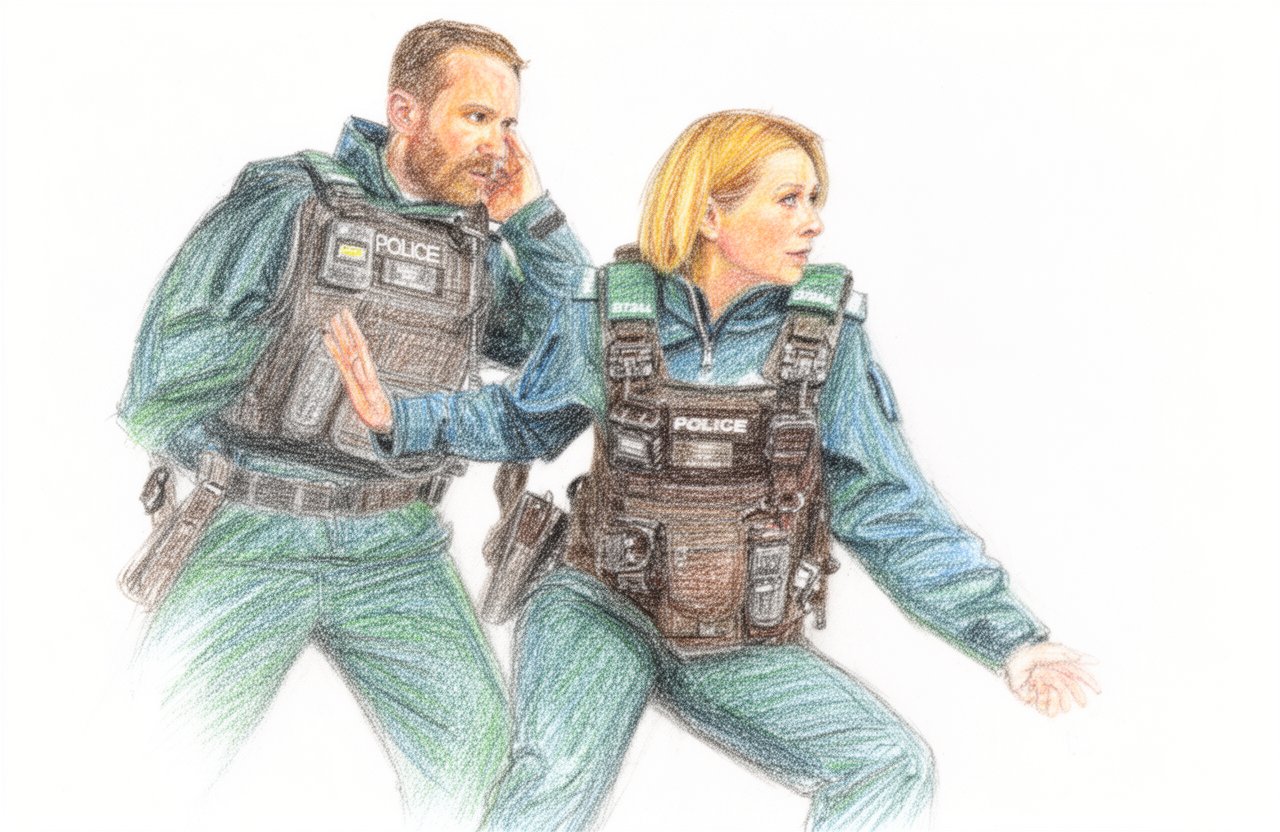
My Critique of Blue Lights
Blue Lights remains a rare procedural built on procedural humility, foregrounding probationers’ inexperience and frontline decisions over glamourised investigation. Its strongest asset is an uncompromisingly authentic Northern Irish texture, where sectarian legacies and informer economies shape every patrol and call.
The series balances unshowy craft with ferocious moral pressure, showing how institutional survival can flirt with complicity and quiet compromise. Relative to peers like Happy Valley or Line of Duty, it privileges pressure over plot mechanics and avoids triumphalist closure.
For modern audiences, it matters because policing is rendered as community labour, affected by austerity, security threats, and the weight of local memory. A darker counterpoint is its occasional tonal austerity, where relentless gloom threatens to flatten character nuance and variation.
Yet its grounded focus, sustained ensemble, and refusal of easy heroism anchor Blue Lights as one of British television’s most essential contemporary crime dramas.
Principal Characters & Performances
Constable Grace Ellis
At the heart of Blue Lights is Siân Brooke’s Constable Grace Ellis, a former social worker who joins the Police Service of Northern Ireland as a probationer. Her character is the show’s moral compass, but one that is constantly being tested and recalibrated by the harsh realities of Belfast’s streets.
Grace’s background informs her approach, often leading her to see the vulnerable person behind the crime report, a perspective that sometimes clashes with police protocol. Her journey is one of hardening resolve, not cynicism.
Brooke portrays this evolution with remarkable subtlety, balancing Grace’s innate compassion with the dawning understanding of the systemic and personal dangers she faces. Her performance grounding the series, making Grace’s trials feel intensely personal and her small victories genuinely earned.
The character’s personal life, particularly her role as a mother, is seamlessly woven into the narrative, highlighting the unique security burdens carried by PSNI officers off-duty. Grace Ellis is less a traditional heroic lead and more a compelling study of resilience in a uniquely pressurized environment.
Constable Annie Conlon and Constable Tommy Foster
Grace’s rookie cohort provides crucial contrasting perspectives. Katherine Devlin’s Constable Annie Conlon is all sharp edges and defensive wit, a young woman whose tough exterior masks a deep-seated need to prove herself in a world that expects little from her.
Devlin brings a fierce, unpredictable energy to Annie, making her moments of vulnerability all the more powerful. Her journey explores the personal costs of policing in the community where you grew up.
Nathan Braniff’s Constable Tommy Foster is the wide-eyed newcomer, initially more naive and physically hesitant than his colleagues. Braniff expertly charts Tommy’s growth from a liability to a competent officer, his arc serving as the audience’s most direct entry point into the shock of frontline policing.
Together, this trio ensures the show never loses sight of the steep, often terrifying learning curve that defines a response officer’s first years. Their dynamic is fractious, supportive, and entirely believable.
The Veteran Core
The series is equally defined by its seasoned officers, who embody the institutional memory and weariness of post-conflict policing. Martin McCann’s Constable Steven “Stevie” Neill is a complex mentor figure—capable and charismatic, but harboring his own ambitions and moral compromises.
His evolving relationship with Grace forms a central professional and personal thread. Richard Dormer, as veteran Gerry Cliff, delivers a masterclass in world-weary pragmatism, his performance layered with a deep, unspoken history that speaks volumes about the job’s legacy.
Joanne Crawford’s Sergeant, later Inspector, Helen McNally represents the often-frustrated voice of procedure and integrity within a strained system. Andrea Irvine brings steely authority as Chief Superintendent Nicola Robinson, navigating political pressures, while Hannah McClean, as her officer daughter Jennifer, adds a fraught familial layer to the chain of command.
This ensemble, from leads to supporting players like Jonathan Harden’s Inspector Jonty Johnson and Andi Osho’s Sergeant Sandra Cliff, creates a dense, authentic ecosystem of a police station under relentless pressure.
Key Episodes & Defining Stories
The Code
The series premiere, directed by Gilles Bannier, does far more than introduce characters. It meticulously builds the show’s entire world.
We follow Grace, Annie, and Tommy from their first bewildering day at the fictional Blackthorn station onto the tense streets of Belfast.
The episode establishes the central threat in crime boss James McIntyre and the insidious interference of MI5, immediately framing policing in Northern Ireland as a geopolitical tightrope walk. The mentorship from Stevie Neill and Gerry Cliff isn’t just about procedure; it’s a crash course in survival and compromised ethics.
Fans remember it for its immediate grip and authenticity. The handheld camera work by Stephen Murphy and Angus Mitchell drops you into the passenger seat of the response vehicle.
The dialogue, rich with local idiom, feels lived-in. It set a high bar for British police drama by refusing sensationalism, instead finding tension in the quiet moments of doubt and the looming shadow of history.
Full Moon Fever
This fourth episode is a masterclass in claustrophobic, institutional drama. Centered on a disastrous incident during a chaotic night shift, the story triggers an investigation by the Police Ombudsman.
The focus shifts from street-level threats to the internal enemy of cover-up and blame.
As Helen McNally digs deeper, the episode dissects the “blue code” of silence, asking what loyalty truly costs. For Grace, the professional crisis merges with a domestic one involving her son, powerfully illustrating the job’s 24/7 intrusion.
It’s remembered for its moral complexity and sharp, tense dialogue. There are no easy villains, just a group of stressed officers making terrible decisions under pressure.
Editor Peggy Koretzky’s work here is pivotal, weaving together the control room tension, the aftermath on the street, and the private fears at home into a relentless, ticking clock. It proved Blue Lights was unafraid to scrutinize the very institution it portrays.
Episode 1 (Series 3)
The opening of the third series boldly expands the show’s scope. A routine arrest of a young dealer spirals into an investigation that reaches Belfast’s business and political elite, embodied by the powerful Dana Morgan.
The plot deftly connects organised crime to respectable society, exploring how exploitation filters down to the most vulnerable, like teenager Lindsay Singleton.
This episode showcases a more experienced Grace Ellis, now adept at navigating both street dynamics and inter-agency cooperation with social services. It moves the series convincingly beyond the paramilitary focus of earlier seasons into the murky world of white-collar corruption and child criminal exploitation.
Fans appreciate it for its intricate, confident plotting and its refusal to let its characters rest. It demonstrated that Blue Lights could evolve its narrative ambition without losing its grounded, character-centric heart.
The stakes feel higher because the enemy is now wearing a suit, proving that the shadows in Belfast take many forms.
The World of Blue Lights
Blue Lights is rooted in the specific soil of contemporary Belfast. The fictional Blackthorn station, understaffed and overstretched, is the nerve center for a city still grappling with the legacy of the Troubles.
The show doesn’t use this as mere backdrop; it’s the active ingredient in every call.
Response officers patrol working-class estates where paramilitary influence lingers, where a domestic dispute can be tangled in sectarian history, and where routine drug dealing is often linked to larger, violent networks. The need for security precautions—checking under cars, being wary of home addresses—is depicted as a mundane, exhausting reality.
This isn’t a glossy tour of detective suites. It’s the world of the first responder: the sudden violence, the community tensions, the paperwork, and the gallows humour in the canteen.
The production’s on-location shooting across Belfast, using its distinct streetscapes, imbues every scene with an authentic, palpable sense of place, making the city itself a central, breathing character.
Origin Story
Blue Lights was created and written by Declan Lawn and Adam Patterson, former documentary makers with deep experience in Belfast through work for programmes like BBC Panorama. They drew on this background to craft a drama focused on authenticity.
The series was commissioned for BBC One by executives Piers Wenger and Charlotte Moore and is produced by Two Cities Television with Gallagher Films, BBC Studios, and Northern Ireland Screen. The development process was impacted by the COVID-19 pandemic, forcing parts of the writers’ room online.
French director Gilles Bannier directed the entire first series, bringing a cohesive visual style. The executive production team included Stephen Wright, Louise Gallagher, Tommy Bulfin, and the creators themselves.
This collaboration between local insight and television craftsmanship established the show’s foundational commitment to a naturalistic, grounded portrayal of the Police Service of Northern Ireland.
Narrative Style & Tone
The show employs a naturalistic, procedural style. It follows response officers, not detectives, so the narrative is built from incoming calls, sudden eruptions of violence, and the gradual piecing together of community intelligence.
The visual approach favors handheld camerawork and real locations, creating a sense of immediacy and documentary realism.
Music, composed by Eoin O’Callaghan and Elma Orkestra, is used sparingly, often allowing the ambient sounds of the street or the tense silence of a patrol car to build suspense. The tone balances intense, sometimes brutal action with quieter, character-driven moments and deftly deployed humour among colleagues.
It avoids forensic glamour, focusing instead on dialogue, observation, and the psychological weight of the job. The perspective is often anchored with the probationers, making the audience learn and feel the pressure alongside them, resulting in a drama that is both emotionally immersive and intellectually engaged with its complex setting.
How is Blue Lights remembered?
Blue Lights is remembered as a standout achievement in modern British television drama, a police procedural that earns its stripes through unwavering authenticity and deep character work. It quickly shed any “newcomer” status, with its second series winning the BAFTA Television Award for Best Drama Series.
Critics and audiences praised it for its intelligent engagement with Northern Ireland’s unique social and political landscape, comparing it favorably to benchmarks like Line of Duty and Happy Valley. Its ensemble cast, led by Siân Brooke, received consistent acclaim for performances that felt lived-in and real.
The show secured its place by blending gripping, serialized storylines with a palpable sense of place. It is discussed as a drama that respects its audience’s intelligence, offering no easy answers but plenty of compelling questions about duty, community, and survival in a post-conflict society.
Its inclusion in year-end “best of” lists, like The Guardian’s, cemented its reputation as essential, thoughtful television.
In Closing
Blue Lights succeeds by mastering the fundamentals of its genre while being profoundly shaped by its unique setting. It is a powerful, character-driven exploration of policing that feels both specific to Belfast and universally resonant in its themes of resilience and moral compromise.