
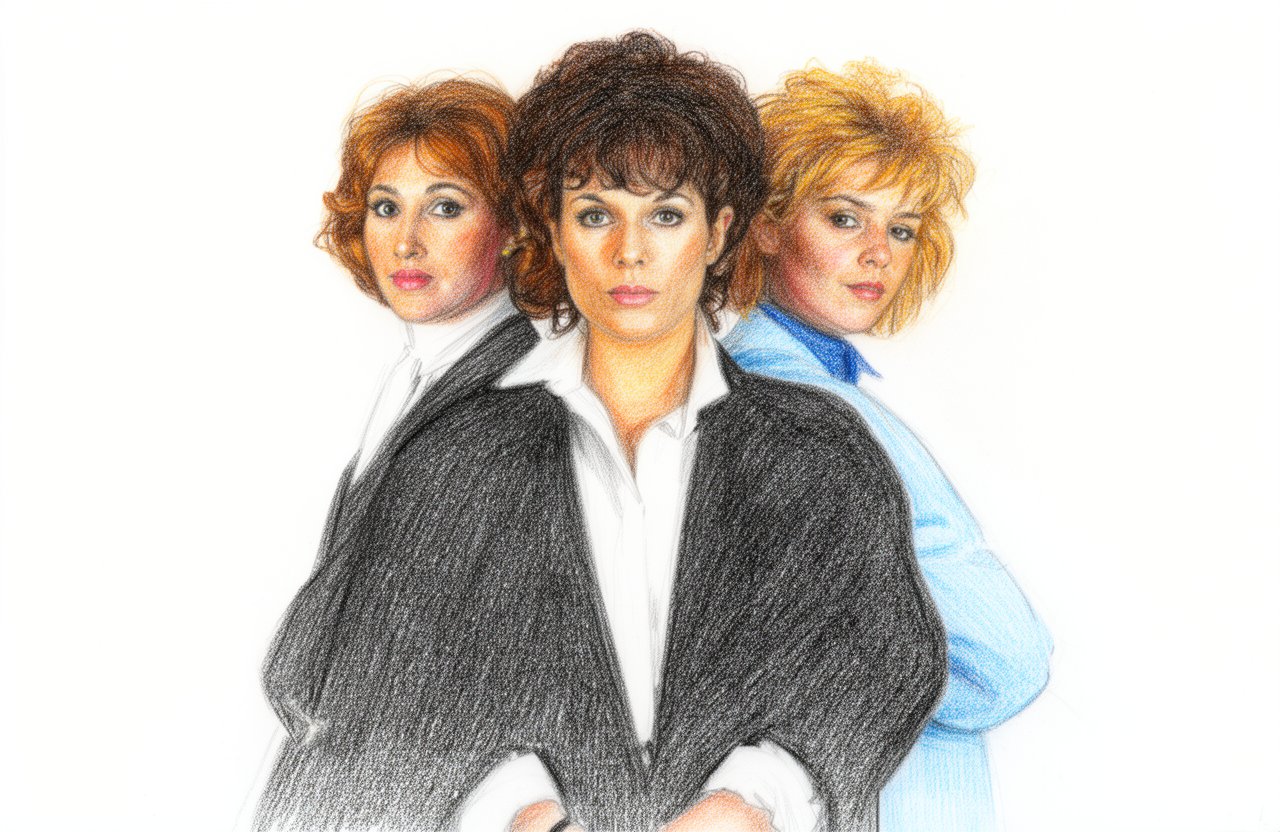
My Critique of CATS Eyes
C.A.T.S. Eyes was a savvy translation of state‑level espionage to regional grit, leveraging an all‑female core that felt rarer then than now.
Its stamina for maritime menace and corporate sleuthing was impressive, especially in the pilot’s Chatham Dockyard texture and Blue For Danger’s escalating jeopardy. As an ITV follow‑up to The Gentle Touch, it kept Jill Gascoine’s Maggie Forbes but pushed from domestic police realism into a brisker, occasionally clunky hybrid of covert ops and provincial surveillance.
For modern audiences, the series’ legacy lies in that calibrated blend of tradecraft and everyday settings, proving British drama could credibly put women at the operational centre of action without insisting on sanctimony.
Principal Characters & Performances
Maggie Forbes
Jill Gascoine’s Maggie Forbes is the anchor of C.A.T.S. Eyes, a direct transplant from the world of The Gentle Touch.
Her arrival in the pilot episode is the catalyst for the series itself. We meet her not as a rookie, but as a seasoned police officer profoundly out of her depth in the murky world of covert operations.
Her initial mishandling of a simple case is a masterstroke of character introduction, highlighting the vast gulf between uniformed procedure and the fluid, often morally grey work of the Thames Section. This tension defines her early arc.
When she assumes leadership in the second series, it feels earned. Gascoine plays Maggie with a compelling blend of grit, intuition, and a lingering institutional caution.
She is the team’s moral compass and operational backbone, her police background providing a grounded counterpoint to the more unorthodox skills of her colleagues.
Her presence provides crucial continuity for viewers and firmly roots this spin-off in a recognizable, credible reality.
Frederica “Fred” Smith
Leslie Ash’s Fred is the show’s secret weapon and its most forward-looking creation. In an era when computers were mysterious behemoths, Fred was the streetwise expert who could talk to them.
She represents a new breed of operative, where technical prowess is as vital as physical courage.
Her background is deliberately vague but suggests a past on the edges of the law, giving her a cynicism and resourcefulness that pure academics or police officers lack. Ash portrays her with a captivating mix of cocky confidence and vulnerable loyalty.
Fred’s skills are not just a plot convenience; they are central to stories like “Love Byte,” which explores data privacy and corporate espionage. She is the bridge between the traditional detective work of surveillance and the dawning digital age, making her character feel remarkably prescient.
Pru Standfast & Tessa Robinson
The ensemble is rounded out by two characters who define the show’s evolution. Rosalyn Landor’s Pru Standfast, the Oxford-educated initial leader, embodies the series’ original conception: cerebral, cool, and connected.
Her presence in the first series establishes the unit’s high-level government links and intellectual heft.
Her departure marked a significant shift. Tracy Louise Ward’s Tessa “Tess” Robinson, who joins in the second series, brings a different energy.
Upper-class and initially somewhat naive, Tess’s integration into the team allowed for stories about class and privilege within the framework of covert action.
Don Warrington, as the civil servant Nigel Beaumont, provides the essential link to the Home Office. His performances are a study in bureaucratic ambiguity, offering support with one hand while reminding the team of their expendability with the other.
Key Episodes & Defining Stories
Goodbye Jenny Wren
The 90-minute pilot is essential viewing, not just as an introduction but as a statement of intent. It efficiently kills off one operative to establish the stakes, then builds a new team in the aftermath.
The dual plot is key: Fred’s personal, vengeful pursuit of a Russian spy ship contrasts sharply with Maggie’s fumbling of a mundane adultery case.
This juxtaposition lays out the series’ entire palette—Cold War espionage, personal jeopardy, and the messy reality of investigation—all within the evocative, rain-slicked confines of Chatham Dockyard. It’s here we meet Pru Standfast and Nigel Beaumont, understanding the unit’s official cover and its shadowy oversight.
Fans remember it for its atmospheric location work and for seamlessly transitioning Jill Gascoine’s iconic character into a bold new format. It’s the solid foundation upon which every subsequent mission is built.
Love Byte
This episode is a standout for how it engages with technology. At its heart is a classic blackmail plot, but the mechanism is thoroughly modern for 1985: the abuse of a company’s computerised client database.
The episode smartly uses Fred’s expertise not as magic, but as skilled detective work, tracing digital footprints.
It’s a story that feels ahead of its time, tapping into nascent anxieties about data privacy and corporate surveillance long before they became daily concerns. The threat isn’t a man with a gun, but a man with a terminal and a profit motive.
For fans, “Love Byte” showcases the series’ commitment to relevance and highlights Leslie Ash’s Fred as the team’s indispensable tech pioneer. It proves the show could find compelling drama in the virtual world as well as on the Thames.
Blue For Danger
Often cited as one of the series’ most tense and atmospheric hours, this first-series finale exemplifies the show’s narrative power. It begins with the quintessential private-eye premise: a wife suspecting infidelity.
This relatable, domestic starting point makes the escalation into deep-water smuggling and organised crime all the more effective.
The episode masterfully uses its Kent coastline locations, transforming the familiar estuary into a landscape of menace. The danger feels tangible and environmental, with the river itself becoming a character—a conduit for threat.
It’s remembered for its relentless pacing and for placing Maggie in a genuinely perilous confrontation, underscoring the physical risks these operatives took. “Blue For Danger” is a perfect capsule of what the series did best: starting small and personal, and expanding into a story with life-or-death stakes, all grounded in its distinctive maritime setting.
The World of C.A.T.S. Eyes
The environment of C.A.T.S. Eyes is a character in itself.
The Covert Activities Thames Section is rooted in the specific geography of South-East England. The closed Chatham Dockyard, with its vast, empty sheds and echoing quaysides, provides a uniquely atmospheric and plausible base for a secret unit.
Operations sprawl across the Thames Estuary, into Kentish towns like Maidstone, and along the coastline. This isn’t a glamorous world of Whitehall or Mayfair; it’s one of industrial ports, damp motorways, and suburban streets.
The blend is crucial.
The Eyes Enquiry Agency front gives them a foot in the mundane world of marital disputes and missing persons, while their government brief pulls them into espionage and high-stakes crime. This duality defines their world—a place where a routine tail job can suddenly intersect with national security, all under the grey skies of the Thames corridor.
Origin Story
C.A.T.S. Eyes was created by writer Terence Feely as a deliberate spin-off from the successful police drama The Gentle Touch.
Television South (TVS), the ITV franchise holder for the region, produced it. Executive producer Rex Firkin oversaw the project, with producers including Raymond Menmuir.
The concept took Jill Gascoine’s popular character, Detective Inspector Maggie Forbes, and placed her in a new, more action-oriented context. A 90-minute pilot was commissioned to launch the series.
Crucially, the production was shot entirely on location, using the disused Chatham Dockyard as a primary base, giving the show an immediate and authentic visual texture distinct from studio-bound contemporaries.
Narrative Style & Tone
The series operates as a hybrid crime procedural and espionage thriller. Episodes are largely self-contained cases that balance investigative legwork, undercover sequences, and action.
The tone is primarily serious crime drama, but allows for lighter moments of camaraderie among the team.
It moves at a brisk pace, emphasising the practicalities and dangers of covert work. The style is grounded and contemporary for its time, avoiding the overt glamour of some spy fiction.
The music, from composers like John Kongos and Barbara Thompson, complements this with a synthesizer-driven theme that feels both urgent and of its mid-1980s moment.
How is C.A.T.S. Eyes remembered?
C.A.T.S. Eyes is remembered as a ratings-successful product of its era that carved out a distinctive niche.
Its legacy rests on two pillars. First, its focused portrayal of an all-female professional team operating at the sharp end of security work was a notable step in 1980s British television.
Second, its strong regional identity, forged through extensive location filming in Kent, made it a showcase for TVS. While its afterlife has been hampered by complex rights issues limiting repeats and releases, it maintains a cult appreciation.
For fans of British crime drama, it represents a fascinating bridge: a spin-off that pivoted into a more action-driven format, a police procedural that embraced espionage, and a show that placed women firmly in charge of both the investigations and the narrative.
In Closing
C.A.T.S. Eyes stands as a compelling, atmospheric chapter in the history of ITV crime drama, defined by its strong lead performance, unique setting, and a confident blend of everyday detective work and high-stakes covert operations.