My Critique of Minder
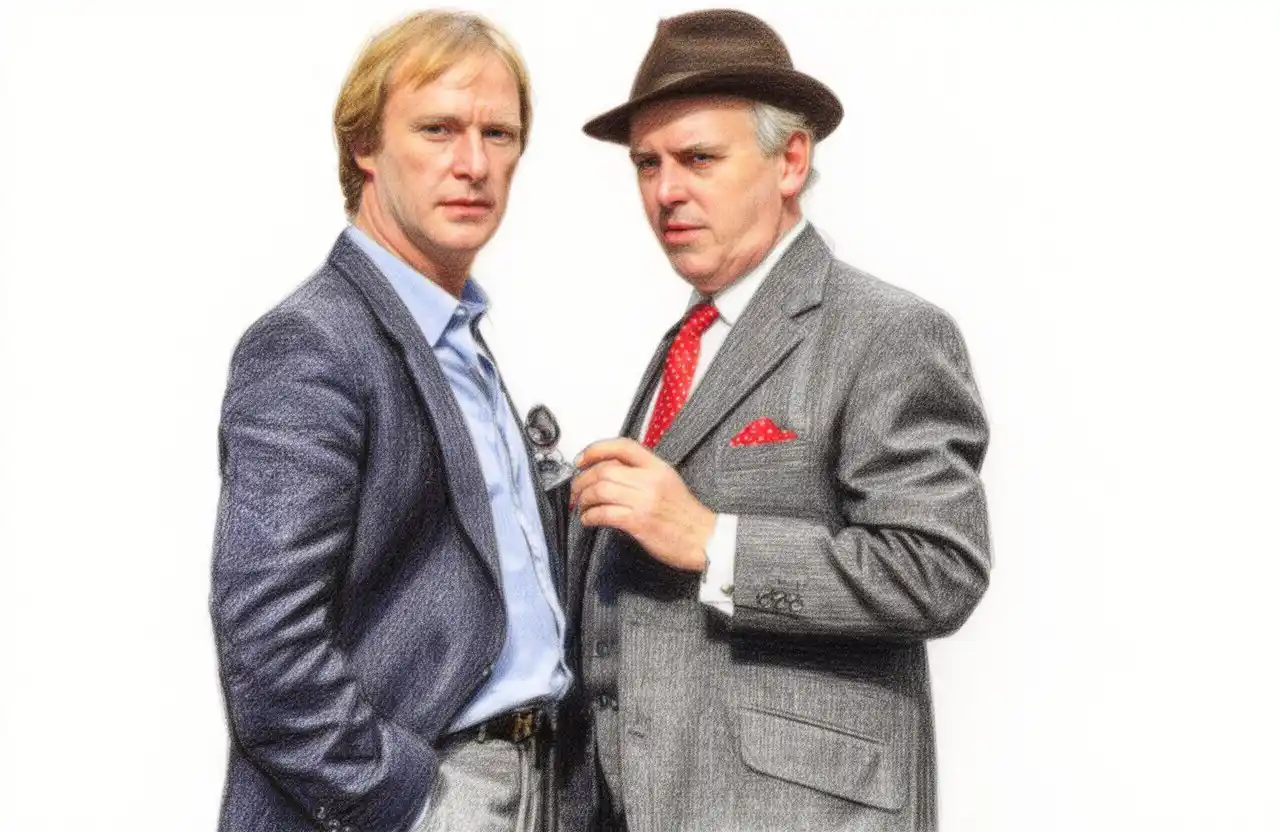
Minder’s enduring success rests on the friction between George Cole’s wheeler-dealing Arthur and Dennis Waterman’s grounded Terry, yielding dialogue sharp enough to outclass most contemporaries. The comedy, however, is frequently anchored in grubby survivalism, where resourcefulness shades into exploitation.
Its depiction of Thatcher-era London offers a richer social tapestry than many metropolitan procedurals, yet the reliance on slang and episodic scams can feel insular. For modern viewers, the show remains a valuable, if uneven, document of low-level enterprise.
Principal Characters & Performances
Arthur Daley
George Cole’s Arthur Daley is the undeniable heart of Minder. He is a small-time entrepreneur whose ambitions consistently outstrip his scruples and his capital.
Operating from lock-ups and car lots in west London, Arthur is a master of the dodgy deal, the bent motor, and the get-rich-quick scheme that never quite pans out.
Cole’s genius was in making this fundamentally untrustworthy character not just watchable, but oddly endearing Arthur’s patter, a blend of faux-respectability and Cockney slang, is a defensive mechanism. He is a man perpetually on the edge of respectability, terrified of both the police and the genuine hard men he tries to emulate.
His relationship with his minder is that of a needy, manipulative uncle, constantly testing loyalties. Cole played him not as a villain, but as a survivor, a comic archetype of Thatcher-era enterprise.
The performance earned him a BAFTA nomination and cemented Arthur Daley as a permanent fixture in the British television lexicon.
Terry McCann
Dennis Waterman brought a grounded, muscular decency to the role of Terry McCann, the ex-boxer who becomes Arthur’s “minder”. Terry is the show’s moral compass, frequently dragged into Arthur’s schemes against his better judgment.
His strength is physical, but his true role is as a protector, often of Arthur from himself.
Waterman’s portrayal is key to the series’ tone. Terry’s weary sighs and eye-rolls in response to Arthur’s latest folly provide the audience’s point of view.
He is a man trying to go straight, finding that honest work is scarce, which makes his reliance on Arthur a constant source of tension.
This dynamic, the banter between the opportunistic Arthur and the principled Terry, defined the show’s first seven series. Waterman also performed the iconic theme song, “I Could Be So Good for You”, making Terry’s voice the literal and figurative sound of the classic Minder era.
The Supporting Ensemble
The world around Arthur and Terry was populated by a rich ensemble that gave Minder its authentic texture. Glynn Edwards, as Dave the barman of the Winchester Club, was the series’ quiet anchor.
His pub provided a neutral sanctuary and Dave’s weary tolerance of Arthur’s bluster was a running joke.
Patrick Malahide’s Detective Sergeant Chisholm and Peter Childs’s DS Rycott represented the long arm of the law, often just as frustrated by Arthur’s slippery nature as Terry was. Guest stars like Ray Winstone as the dim mechanic Arnie, or Anthony Valentine as the suave gambler Maurice Michaelson, filled out a believable rogues’ gallery.
When Waterman departed, Gary Webster stepped in as Arthur’s nephew, Ray Daley. Webster brought a different energy; Ray was more educated and aspirational, creating a new friction.
This recasting proved the durability of the format, with George Cole’s Arthur remaining the constant sun around which all other characters orbited.
Key Episodes & Defining Stories
Gunfight at the O.K. Laundrette
The debut episode from 1979 does more than just introduce the characters; it establishes the entire moral and social landscape of the series. Terry, fresh out of prison and needing work, takes what seems a simple protection job for Arthur at a laundrette.
It swiftly escalates into a hostage siege with armed robbers.
The episode is a masterclass in low-key tension and social observation. Terry is trapped inside, forced to be the negotiator, while Arthur buzzes outside, more concerned with his damaged reputation than the human crisis.
The setting, a grimy North London laundrette, immediately grounds the show in a very real, struggling urban Britain.
Fans remember it as the perfect blueprint. It showcases the core relationship, blends genuine crime drama with character-based humour, and sets the tone for every deal-gone-wrong to follow.
It proved the concept worked, securing Minder’s future and defining its unique voice from the very first hour.
Second Hand Pose
By 1984, Minder was a ratings juggernaut, and this episode represents the show at the peak of its popularity, attracting over sixteen million viewers. The plot is quintessential Arthur Daley: a batch of used cars with dubious histories leads him into a maze of insurance fraud and angry customers.
Guest actor George Baker brings a steely menace as a rival dealer, highlighting the real danger that often lurks behind Arthur’s comedic scams. The episode works because it perfectly balances the farcical elements of Arthur’s wheeler-dealing with the genuine threat of criminal repercussions.
It matters because it captures the spirit of mid-80s Britain, where enterprise was king but the lines between sharp practice and crime were often blurred. It is remembered as perhaps the most iconic example of a standard Minder caper executed to perfection, with Cole and Waterman’s chemistry firing on all cylinders.
The Loneliness of the Long Distance Entrepreneur
This 1991 episode is a pivotal moment in the series’ history. It deals directly with the off-screen departure of Terry McCann, who has married and moved to Australia.
Arthur, suddenly vulnerable, is forced to recruit his nephew, Ray Daley, played by Gary Webster.
The story cleverly uses Ray’s first job—collecting a car from Brussels that turns out to be linked to drug traffickers—as his baptism of fire. The dynamic shifts instantly; Ray is more skeptical and less physically imposing than Terry, forcing Arthur to adapt his manipulations.
Fans remember it as a brave and successful reboot. It proved the show’s concept was durable enough to survive the loss of a lead, because the central character was always Arthur.
The episode smoothly transitions the series into the 1990s, maintaining its core while refreshing the formula, ensuring Minder’s story had more chapters to tell.
The World of Minder
Minder is irrevocably tied to the streets of west London. This isn’t a glamorous tourist’s view, but a ground-level portrait of Shepherd’s Bush, Acton, and Fulham.
The environment is one of lock-up garages, bustling street markets, and grimy pubs. Arthur Daley’s office is his car, usually a Jaguar, cruising these streets in search of opportunity.
The Winchester Club is the series’ vital organ, a private members’ drinking den that serves as a sanctuary, a meeting room, and a neutral territory. Here, deals are brokered, gossip is exchanged, and Dave serves pints with stoic indifference.
This world is populated by a ecosystem of small-time thieves, wary police, struggling shopkeepers, and aspirational chancers like Arthur.
It presents a complete, self-contained universe of low-level commerce and crime. The show’s authenticity came from Euston Films’ commitment to location shooting, making the urban backdrop a character in itself.
This is a world where everyone has an angle, but community, however fractious, still exists around the bar of the Winchester.
Origin Story
Minder was created by writer Leon Griffiths specifically as a vehicle for Dennis Waterman, who was popular following his role in The Sweeney. The producer Verity Lambert and Euston Films, a subsidiary of Thames Television, developed the series for ITV.
It was conceived as a character-driven comedy-drama that could utilise Waterman’s physical presence but pivot into humour.
The first episode aired in October 1979. The production broke from studio-bound tradition, opting for location-heavy shoots around London to achieve a grittier, more realistic feel.
This approach, combined with Griffiths’ sharp scripts and the immediate chemistry between Waterman and George Cole, defined the show’s distinctive style from the outset.
Narrative Style & Tone
Minder operates in the space between crime drama and character comedy. While plots often involve theft, fraud, or protection rackets, the tone is rarely grim.
The focus is on the farcical fallout of Arthur’s schemes and the verbal sparring between him and his minder. Violence is present but often undercut by humour or its own clumsiness.
Episodes are typically self-contained capers, following a reliable pattern: Arthur concocts a deal, Terry reluctantly gets involved, complications ensue from both criminals and police, and resolution arrives with Arthur usually unscathed and unrepentant. The dialogue is rich with Cockney rhyming slang and London vernacular, grounding the humour in a specific place and class.
The show is a social observation wrapped in entertainment. It finds comedy in the hustle, pathos in the struggle, and a strange honour in the chaotic world of its likeable rogues.
How is Minder remembered?
Minder is remembered as a defining British television series of its era. It achieved massive mainstream popularity during its original run, becoming one of ITV’s most-watched dramas.
Its legacy is twofold. First, it created an iconic character in Arthur Daley, a name that became shorthand for a certain type of wheeler-dealer.
Second, it popularised the term “minder” itself in common British parlance.
Critically, it is celebrated for its successful blend of genres and its authentic portrayal of London life. The partnership of Cole and Waterman is regarded as one of the great double-acts in TV history.
Following the deaths of both lead actors, retrospectives consistently highlighted Minder as their career-defining work.
Through constant reruns on channels like ITV4, the series has been introduced to new generations. It endures not just as a period piece, but as a brilliantly executed character study set against a vividly realised urban backdrop, its humour and humanity remaining perfectly intact.
In Closing
Minder offers a timeless package: sharp writing, unforgettable characters, and a uniquely British view of life on the edges. Its enduring appeal lies in the perfect alchemy of Arthur Daley’s boundless chutzpah and the weary decency of the minders who watched his back.