
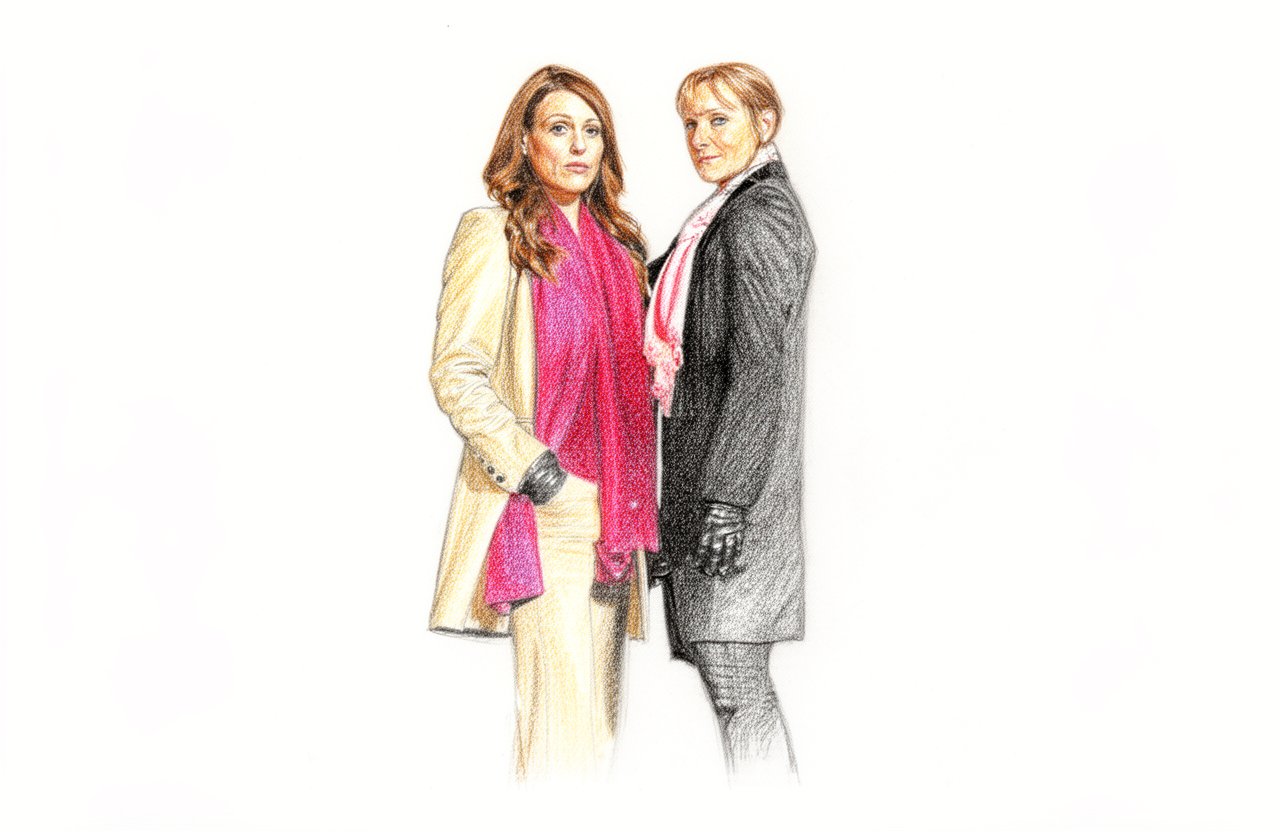
My Critique of Scott and Bailey
Scott & Bailey delivers a grounded procedural by treating partnership as its dramatic engine rather than a backdrop. Its blend of credible investigative detail and character strain, anchored by Jones and Sharp, honours the legacy of Cagney & Lacey while feeling authentically Manchester.
Yet the series repeatedly tests that rapport with self-sabotage and institutional friction, and some case-week plots can settle into familiar beats. For modern viewers, it matters precisely because it normalises women’s expertise and collaborative policing without fuss, granting messy lives alongside professional competence.
The result is a drama that persuades through craft and restraint, earning its place among Britain’s finest contemporary crime procedurals.
Principal Characters & Performances
Detective Rachel Bailey
Suranne Jones brings a compelling, kinetic energy to Detective Constable Rachel Bailey. The character is a brilliant, instinctive detective whose professional sharpness is perpetually at odds with her chaotic personal life.
From the first episode, we learn she is entangled with a married barrister, Nick Savage, a pattern of self-destructive relationships that becomes a central arc. Her backstory, including a fraught relationship with her mother Sharon, informs her impulsive nature.
Jones portrays Bailey’s vulnerability and resilience with equal force, making her professional triumphs feel hard-won. The performance avoids easy heroics, instead showing a woman learning, often painfully, to navigate office politics and her own demons.
Her journey from a talented but raw DC to a sergeant contending with leadership is the series’ core engine. Jones, who co-devised the original concept, earned a National Television Awards nomination for her layered work.
Detective Janet Scott
Lesley Sharp‘s Detective Constable Janet Scott is the perfect counterweight to Rachel Bailey. As a seasoned detective and a working mother, Scott embodies stability and meticulous procedure.
Her home life with her daughters and her evolving relationship with colleague Andy Roper grounds the series in domestic reality.Sharp excels at portraying quiet authority and deep empathy. Scott is the team’s emotional anchor, often mediating between Bailey’s impulsiveness and their boss’ demands.
Her strength is in her calm, observant nature, a different but equally vital form of policing.The partnership works because Sharp and Jones forge a believable, non-competitive friendship. Scott’s loyalty is tested repeatedly by Bailey’s crises, but their mutual professional respect never wavers.
Sharp makes Scott’s compromises and wisdom profoundly relatable.
Detective Chief Inspector Gill Murray
Amelia Bullmore’s performance as DCI Gill Murray is a masterclass in authoritative yet human leadership. As the head of Syndicate 9, Murray is sharp, dryly witty, and fiercely protective of her team’s integrity.
Bullmore, who also wrote several episodes, imbues Gill with a world-weary pragmatism.
She navigates institutional pressure from superiors like Detective Superintendent Julie Dodson, played by Pippa Haywood, while shielding her detectives. Gill’s own personal life, including a complex relationship with her ex-husband, is subtly woven in, adding depth without melodrama.
Her kidnapping in the series three finale, “Futures,” showcases Bullmore’s range, balancing vulnerability with steely resolve. Gill Murray stands as one of British television’s most credible and compelling police commanders.
Notable Support and Guest Stars
The series boasted a strong supporting cast that enriched its world. Nicholas Gleaves brought warmth and complexity as DS Andy Roper, Janet’s colleague and love interest.
Danny Miller joined as DC Rob Waddington in series three, adding a new dynamic to the incident room.
Sally Lindsay, who helped devise the show’s concept, appeared as Rachel’s sister, Alison Bailey, tying the professional to the familial. Guest stars delivered powerful turns, such as Tracie Bennett as Rachel’s estranged mother, Sharon, and Nicola Walker as Helen Bartlett in series three.
Walker’s portrayal of a woman connected to a historic crime was particularly haunting. These performances ensured the world of Syndicate 9 felt populated by real people, with lives and histories that extended beyond the incident room whiteboard.
Key Episodes & Defining Stories
Episode 1
The debut episode is essential viewing for establishing the series’ DNA. It introduces DCs Rachel Bailey and Janet Scott investigating the suspicious death of a young Turkish woman, a case hinting at honour-based violence.
The procedural detail, informed by consultant Diane Taylor’s real policing experience, is established immediately. Crucially, the episode intercuts this methodical work with the bombshell in Rachel’s personal life: discovering her lover is married.
This dual focus defines the show’s approach. We see Janet managing the case alongside school runs, sketching the show’s commitment to portraying working mothers.
The partnership is cemented not through grand speeches but through shared glances and professional shorthand in the incident room.
Fans remember it for its confident tone, the immediate chemistry between Jones and Sharp, and its declaration that this would be a police drama grounded in emotional and procedural authenticity from the very first scene.
Futures
The series three finale, “Futures,” represents the show operating at peak intensity. The long-running Joe Bevan serial killer investigation reaches its climax with the kidnapping of DCI Gill Murray by an associate.
This episode shifts the focus onto the team’s desperate search for their boss, showcasing their collective skill and deep loyalty. Amelia Bullmore delivers a powerhouse performance, portraying Gill’s fear and resilience under extreme duress.
The resolution of the Bevan case is satisfyingly complex, avoiding simple answers and dealing with the grim legacy for the killer’s family. It matters because it tests the unit’s core, proving their bond is professional and profoundly personal.
Fans recall the palpable tension and the emotional payoff, solidifying Gill Murray as the heart of Syndicate 9. It’s a masterful blend of character drama and high-stakes investigation.
Superficial
The fourth series opener, “Superficial,” is a key episode for reconfiguring the show’s central dynamic. Both Rachel and Janet have passed their promotion boards, and DCI Murray must choose which will become sergeant.
This injects a genuine, nuanced tension into their friendship, exploring professional ambition and envy without resorting to catty rivalry. The concurrent case, a body found in a quarry, mirrors themes of hidden identities and superficial judgements.
The episode is crucial for character development, forcing both women to examine their careers and their partnership. It demonstrates the show’s willingness to evolve its characters, letting them succeed and then dealing with the complicated aftermath.
Fans appreciate it for its mature handling of workplace rivalry and its reaffirmation that the Scott-Bailey partnership, though strained, is ultimately unbreakable. It pushed the series into new dramatic territory.
The World of Scott & Bailey
Scott & Bailey is firmly rooted in Manchester. The city is not just a backdrop but a character, with filming across Greater Manchester in locations from city-centre streets to suburban homes and bleak moorland.
The nerve centre is the Syndicate 9 Major Incident Team’s incident room. Early series used an ex-bank in Bury; later, the show moved to a former police station on Grey Mare Lane in Beswick.
These authentic, unglamorous spaces ground the drama.
The show’s world extends to Manchester Crown Court for legal proceedings and HM Prison Risley for custodial scenes. This geographic authenticity creates a cohesive, believable environment.
The cases feel part of the city’s fabric, and the detectives’ lives, from Rachel’s flat to Janet’s family home, are situated in recognisable Greater Manchester neighbourhoods.
This tangible sense of place is a cornerstone of the series’ gritty, realistic tone, distinguishing it from more generic crime dramas.
Origin Story
The concept for Scott & Bailey originated from actresses Suranne Jones and Sally Lindsay, who wanted a drama centred on two professional women detectives. They brought the idea to writer Sally Wainwright.
Wainwright then developed the series in collaboration with former Greater Manchester Police detective Diane Taylor, who provided crucial procedural expertise as a consultant producer. The Manchester-based Red Production Company, with executive producer Nicola Shindler, produced the show.
This collaboration between creative talent and real-world experience was fundamental. It ensured the show’s investigative heart was credible, while Wainwright’s skill guaranteed complex characters and sharp dialogue.
The show was born from a desire to see a specific, realistic female partnership on screen.
Narrative Style & Tone
Scott & Bailey is a police procedural with a strong serialised backbone. Each episode typically features a self-contained case, but the detectives’ personal lives unfold in long-running arcs across series.
The tone is gritty and authentic, prioritising realistic investigative procedure over sensationalism. Dialogue is a key strength, filled with workplace banter, detailed investigative discussion, and naturalistic exchanges that reveal character.
The visual style is grounded, using a mix of location shooting and interior sets to reflect contemporary Manchester. The series expertly intercuts professional and domestic spheres, showing how each impacts the other.
It foregrounds collaboration over lone genius, depicting policing as a team effort. The style is conversational, methodical, and deeply character-driven, making the drama feel earned and observed rather than manufactured.
How is Scott & Bailey remembered?
Scott & Bailey is remembered as a benchmark for the female-led British police procedural. It was consistently praised for its complex, credible lead characters and for portraying a professional friendship between women built on respect, not rivalry.
Its commitment to procedural realism, thanks to Diane Taylor’s input, gave it a distinctive authenticity. Critics and audiences valued Sally Wainwright’s writing for its sharp characterisation and the show’s nuanced exploration of working mothers under pressure.
The series concluded in 2016 after five series by creative choice, leaving a loyal fanbase. It is referenced in industry commentary as a key example of improved representation of women in crime drama.
Its legacy is a sophisticated, character-rich show that proved procedural crime could be deeply human, anchored by powerhouse performances from Suranne Jones, Lesley Sharp, and Amelia Bullmore.
In Closing
Scott & Bailey stands as a high-water mark in British television crime drama. Its intelligent focus on partnership, its unwavering authenticity, and its superb central performances ensure its place as a definitive and deeply rewarding series.