My Critique of Softly Softly: Task Force
Softly, Softly: Task Force commendably prioritised procedural rigour over sensationalism, distinguishing itself from contemporaries like The Sweeney through its measured pace and emphasis on methodical investigation. Stratford Johns and Frank Windsor provided gravitas, yet the series was not immune to missteps; the on-screen killing of a police dog in “Escort” proved a tonally jarring miscalculation that provoked understandable public outrage.
The drama’s lasting worth lies in its sober treatment of institutional prejudice and fragile procedure, offering a clear-eyed template for later, more psychologically complex British crime series.
Principal Characters & Performances
Detective Chief Superintendent Charlie Barlow
Stratford Johns’s Charlie Barlow is the gravitational centre of the Task Force. He is a force of nature, a detective whose bullish confidence and intuitive leaps are as legendary as his short temper.
Barlow is not a subtle man, but he is a brilliant one. His methods often involve prodding, provoking, and cutting through bureaucracy to get to the heart of a case.
Johns brought a formidable physicality and a sharp wit to the role, making Barlow both intimidating and compelling. The character’s genius lies in his contradictions.
He can be dismissive yet fiercely loyal to his team, arrogant yet capable of profound self-doubt when the evidence turns against his instincts.
This complexity is the engine of many episodes, as seen when his certainty leads him astray. Barlow represents an older, more instinctive school of policing, and his clashes with procedure or his own superiors are a recurring source of drama.
Johns ensures he is never a caricature, grounding him in a gritty, believable reality that made Barlow a television icon.
Detective Chief Superintendent John Watt
If Barlow is the blunt instrument, Frank Windsor’s John Watt is the scalpel. Initially Detective Superintendent before his promotion, Watt is the operational manager, the calm and methodical counterweight to Barlow’s storms.
Where Barlow charges in, Watt assesses, plans, and deploys. Windsor’s performance is a masterclass in quiet authority.
He conveys intelligence and integrity through measured dialogue and thoughtful silences. Watt is the diplomat, often smoothing the feathers Barlow has ruffled, both within the force and with the public.
His leadership style is based on meticulous procedure and trust in his team’s diverse skills.
Watt’s personal life, notably his relationship with Dr. Jean Morrow (Gay Hamilton), is woven into the series, adding depth without overwhelming the procedural focus.
The dynamic between Windsor’s Watt and Johns’s Barlow is the core partnership of the series, a fascinating study in contrasting but complementary approaches to command and justice.
The Task Force Ensemble
The series thrives on its ensemble, with several characters evolving significantly over its run. Norman Bowler’s Harry Hawkins provides crucial backbone, rising from inspector to detective chief inspector.
He is the reliable, competent officer who often executes the detailed plans born from Barlow’s hunches or Watt’s strategies.
Terence Rigby’s PC Henry Snow, the dog handler, offers a direct link to uniformed policing and a different kind of vulnerability, most famously in the episode concerning his dog. David Lloyd Meredith’s Bob Evans represents the career detective climbing the ranks, his journey from sergeant to inspector mirroring the passage of time within the force.
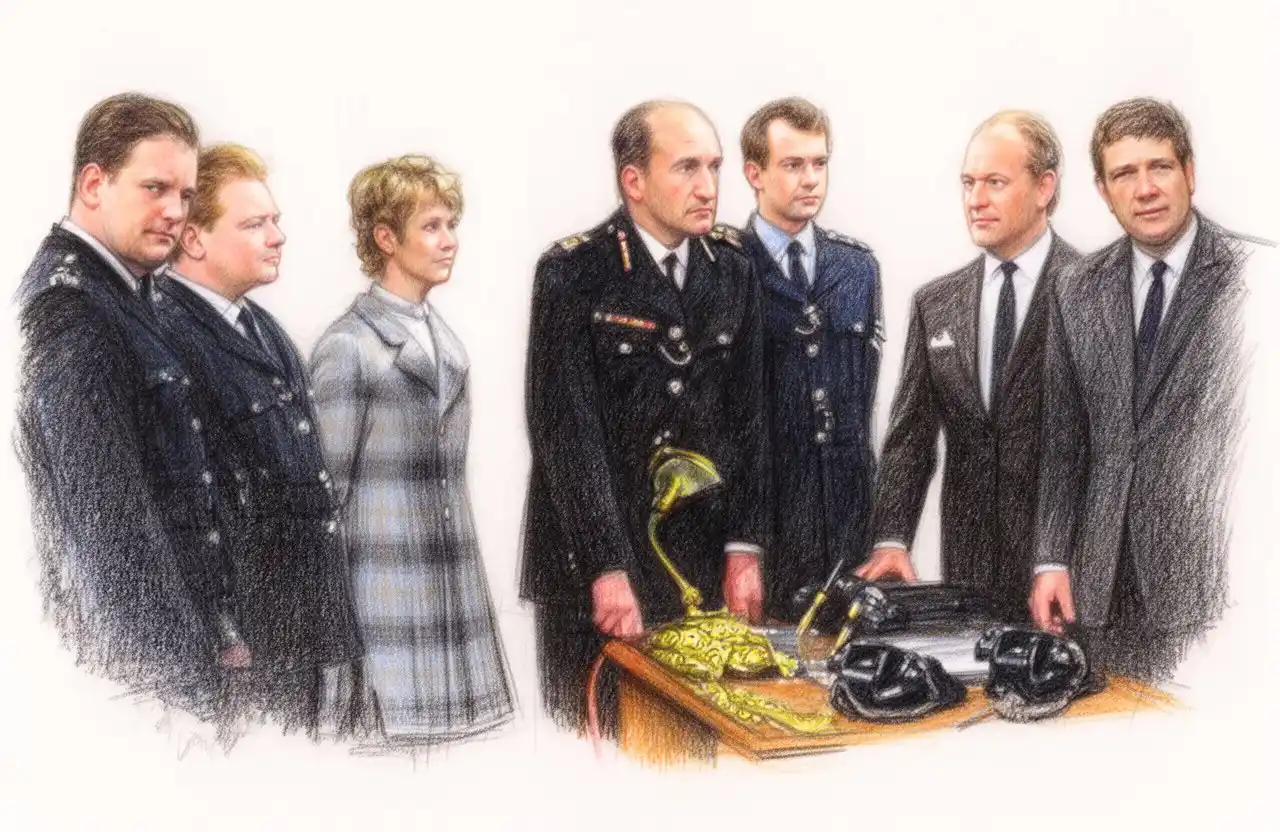
Walter Gotell brings imposing presence as Chief Constable Arthur Cullen, the top brass with whom Barlow frequently locks horns. Later additions like Peter Childs as DS Don Grant and Philippa Howell as WPC Betty Arthur kept the ensemble fresh.
The strength of these supporting performances sold the concept of a cohesive, multi-disciplinary unit tackling complex crimes together.
Key Episodes & Defining Stories
Open and Shut
This episode is a masterclass in the series’ core strength: deconstructing the police procedural from within. It begins with a seemingly simple domestic murder, a case DCS Barlow believes is wrapped up almost before it begins.
The brilliance of the script lies in how it systematically undermines that confidence.
As inconsistencies surface, Barlow is forced to confront his own prejudices and professional arrogance. The investigation becomes a painstaking process of reconstruction, interviews, and attention to minute detail.
Stratford Johns is given superb material here, showing Barlow’s frustration and gradual acceptance of his error.
It matters because it showcases the show’s intellectual rigour and moral complexity. Fans remember it not for chases or showdowns, but for a compelling psychological journey.
It argues that the greatest obstacle to justice can sometimes be a detective’s own assumptions, making it a definitive statement of the series’ mature, adult approach to crime.
Sprats and Mackerels
This story exemplifies the series’ engagement with gritty, contemporary social issues. The Task Force investigates rumours of illegal immigration at the Eastcote docks, a topic of real public anxiety at the time.
The operation involves deploying WPC Betty Donald undercover, a notable focus for a female officer in a hazardous role.
The episode quickly moves beyond a simple crime bust to depict the human cost of exploitation. The migrants are shown as vulnerable pawns, abandoned and in danger.
The tension comes from a race against time to find them before they come to harm. Written with a documentary-like feel, it highlights the unit’s use of intelligence and covert tactics.
Fans value it for its unflinching realism and social conscience. It’s a prime example of Softly, Softly: Task Force using its police framework to examine wider societal problems, treating its subject with seriousness and empathy, and showcasing the diverse skill sets within the team.
Hostage
For sheer sustained tension and procedural intrigue, “Hostage” stands out. It builds from a series of clever bank robberies into a full-blown siege, a scenario that tests every aspect of the Task Force’s discipline.
The focus is squarely on the mechanics of crisis management: negotiation tactics, command decisions, and the logistical containment of the scene.
Led by Frank Windsor’s calm but resolute John Watt, the episode is a meticulous study of a high-pressure police operation. The criminals’ plan is smart, and their use of hostages raises the stakes dramatically.
The resolution hinges on a detailed procedural point, a classic example of the show’s commitment to authentic police work over sensationalism.
Directed by Brian Parker from a script by Robert Barr and Elwyn Jones, it is remembered for its tight, suspenseful plotting and strong ensemble work. It feels like a blueprint for the modern siege drama, proving that the greatest drama could be found in the careful, tense application of protocol under extreme pressure.
The World of Softly, Softly: Task Force
The series operates within the fictional Thamesford Constabulary, one of the large regional forces created by the real-life amalgamations of the late 1960s. Its focus is Number One Task Force, a specialist unit blending CID and uniformed officers designed to tackle major and complex crimes across the force area.
Their world is the fictional borough of Kingley in south-east England, brought to life through location filming in the Medway towns of Kent, particularly Rochester. Cobham Hall served as the imposing Kingley Hall, the Task Force headquarters.
This setting provided a mix of urban streets, industrial sites, and rural edges, a typical cross-section of a modern constabulary’s challenges.
The environment is deliberately procedural and professional. The incident room with its boards and telephones is a central hub.
Stories take them to airports, football matches, and docks, reflecting the broad remit of a large force. This grounded, authentic backdrop sold the reality of the Task Force as a working part of a modern police structure.
Origin Story
Softly, Softly: Task Force arrived in November 1969 as a revamp and continuation of the earlier BBC series Softly, Softly. Created by writers Troy Kennedy Martin and Elwyn Jones, it was initially conceived simply as “Task Force”.
The BBC decided to keep the established brand, leading to the hybrid title.
The relaunch coincided with BBC1’s move to colour broadcasting, and the new series was produced in colour on videotape and film. It refocused the concept around a dedicated CID-led task force within the large Thamesford Constabulary, moving the setting from the earlier series’ Wyvern region to a more generic south-eastern locale.
This refresh updated the franchise for a new decade and a new technological era of television.
Narrative Style & Tone
The style is pure, dialogue-driven police procedural. Episodes are typically self-contained, fifty-minute investigations emphasizing method over action.
The drama is found in briefings, interviews, and the meticulous piecing together of evidence.
The tone is serious and naturalistic, avoiding comedy subplots or glamour. It presents policing as a collective, often bureaucratic job, punctuated by moments of danger and intellectual breakthrough.
Filming blends studio interiors for offices and homes with location work for exterior realism, creating a believable, unvarnished world. The focus is consistently on serious crime, explored through a lens of professional detail and moral ambiguity.
How is Softly, Softly: Task Force remembered?
It is remembered as a popular, long-running cornerstone of 1970s British television drama, a prime-time fixture that delivered consistent, intelligent procedural storytelling. While not laden with awards, its legacy is one of endurance and influence.
The complete survival of its episodes in the archives has allowed it to endure, with DVD releases confirming a lasting fan base.
Retrospectively, it is cited as a key example of the BBC’s realistic, ensemble-driven crime series, a direct descendant of Z-Cars and a precursor to many that followed. The enduring appeal of characters like Barlow and Watt, who led spin-off series, speaks to their powerful creation.
It is discussed by enthusiasts as a show that took its audience seriously, offering a credible, gritty, and thoughtfully crafted window into the world of policing.
In Closing
Softly, Softly: Task Force stands as a definitive example of the British police procedural, built on strong characters, authentic detail, and stories that prize intellectual rigour over easy spectacle. Its world remains a compelling and convincingly real piece of television history.