My Critique of Spooks
Spooks’ defining strength was its willingness to reconfigure domestic security as visceral, ethically murky drama, a bar it set early with the notorious “Looking After Our Own”.
It frequently matched or eclipsed contemporaries like The Grid through bottle-episode audacity, as in “I Spy Apocalypse”, and by tethering plot to real-world anxieties such as the financial crash in “On the Brink”.
Yet its appetite for shock could curdle into showboating, exemplified by the fryer murder and later the waterboarding in “The Tip-Off”, testing the boundary between candor and gratuitousness.
Even so, the series remains a crucial reference point: a blueprint for how British television proceduralised the War on Terror, interrogating institutional compromise and moral cost with an unsentimental rigor still rare today.
Principal Characters & Performances
Harry Pearce
Peter Firth’s Harry Pearce is the anchor of Spooks, the only character to appear across all ten series. As the head of Section D, he is the moral and operational centre of the show, a man burdened by the weight of impossible decisions.
Firth portrays Harry with a quiet, stoic intensity, his face often a mask of weary resolve. He is a consummate spymaster, fiercely protective of his team yet willing to sacrifice them for the greater good.
This internal conflict defines him.
His complex relationship with analyst Ruth Evershed, played by Nicola Walker, provides the series’ emotional backbone. It is a slow-burn romance built on mutual respect, unspoken understanding, and profound shared loneliness.
Harry’s journey is one of accumulating scars. He navigates political machinations in Whitehall, betrayal from within, and the personal cost of a life in service.
Firth’s performance ensures Harry is never just a bureaucrat, but a deeply human figure in an inhuman world.
Tom Quinn
Matthew Macfadyen’s Tom Quinn is the archetypal Spooks officer introduced in series one. As the senior case officer, he is the audience’s entry point into the high-stakes world of MI5.
Macfadyen brings a compelling blend of steel and vulnerability to the role.
Tom is highly competent and dedicated, but the psychological toll of his work is always visible beneath the surface. His personal life repeatedly collides with his professional duty, a theme that becomes central to his arc.
His relationships with colleagues Zoe Reynolds and Danny Hunter establish the show’s core dynamic. Macfadyen’s departure at the end of series two was a seismic event, proving that no character, no matter how central, was safe.
It set a precedent for the show’s narrative ruthlessness.
Ruth Evershed & Adam Carter
Nicola Walker’s Ruth Evershed is the heart of Spooks. Introduced as a geeky, brilliant analyst seconded from GCHQ, she evolves into the team’s conscience and Harry Pearce’s most trusted confidante.
Walker masterfully conveys Ruth’s intelligence and deep-seated anxiety.
Her value lies not in field craft, but in her ability to connect disparate data points, often seeing the truth others miss. Her quiet strength and moral clarity make her indispensable, and her will-they-won’t-they dynamic with Harry remains one of television’s most nuanced romances.
Rupert Penry-Jones as Adam Carter assumed the lead field officer mantle after Macfadyen’s exit. He brought a different energy; charming, slightly reckless, but utterly reliable.
A former SAS officer, Adam balanced action prowess with a warm domestic life, making his family a recurring target.
His tenure saw the show through some of its most popular years. Penry-Jones delivered a performance that was both heroic and human, cementing Adam as a fan favourite and a worthy successor to Tom Quinn.
Notable Support & Guest Stars
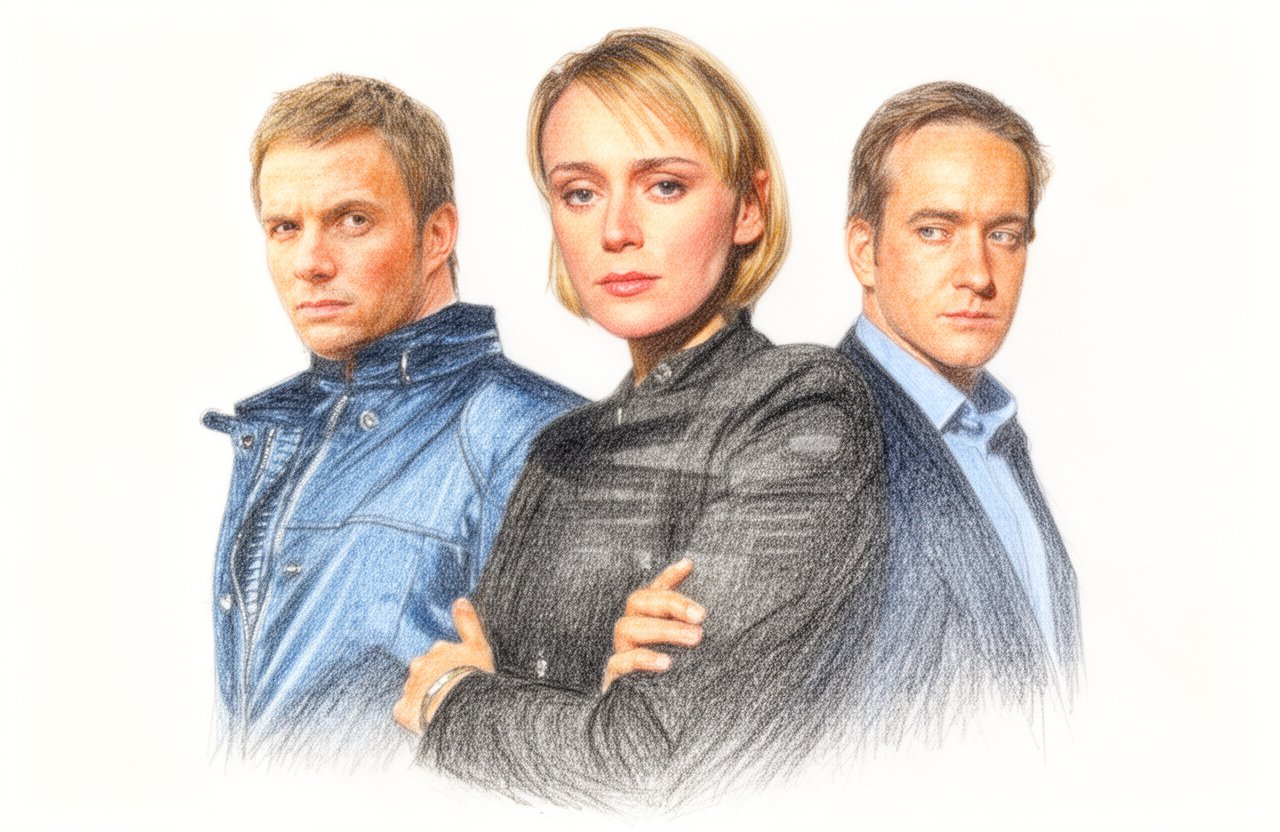
The ensemble cast provided remarkable depth. Keeley Hawes and David Oyelowo, as Zoe Reynolds and Danny Hunter, formed the original core team with Macfadyen, their chemistry immediate.
Hermione Norris brought formidable intensity as the cynical, damaged Ros Myers.
Richard Armitage’s entry as the tortured Lucas North in series seven pivoted the show into darker, more serialised territory. Miranda Raison’s Jo Portman journeyed from journalist to officer, her idealism constantly tested.
Raza Jaffrey’s Zafar Younis offered steady competence.
Guest stars were consistently top-tier. Actors like Kevin McNally, Paul Rhys, and Ariyon Bakare often appeared as antagonists, bringing gravity and complexity to roles that could have been mere plot devices.
Their performances elevated standalone episodes into memorable confrontations.
Key Episodes & Defining Stories
Looking After Our Own
This second episode ever broadcast announced Spooks’ brutal narrative rules. Tom Quinn and Helen Flynn infiltrate the household of far-right demagogue Robert Osbourne, played by Kevin McNally, to prevent orchestrated race riots.
The plot converges on trafficked refugees and extremist networks, but the episode is forever defined by its climax. After her cover is blown, Helen, played by Lisa Faulkner, is tortured and killed by being forced into a deep-fat fryer.
The shocking realism of the sequence generated one of the highest complaint counts to the BBC in 2002. It was a declaration of intent.
The show would not shy from violence, and no character was safe, cementing its reputation for ruthless unpredictability from the very start.
I Spy Apocalypse
This bottle episode from series two is a masterclass in claustrophobic tension. The team is locked down for an Extreme Emergency Response Initiative Exercise, a simulated catastrophic attack on London.
As communications fail and Harry Pearce appears deathly ill, the line between drill and real disaster blurs. With guest star Justin Salinger as a journalist scrutinising their every move, the episode strips away action for pure psychological pressure.
It focuses intensely on leadership, paranoia, and moral decision-making under existential threat. Fans remember it for its high-concept premise, its focus on core character dynamics under stress, and its prescient exploration of post-9/11 emergency planning anxieties.
On the Brink
This series seven episode demonstrated Spooks’ unique ability to dramatise contemporary crises. It directly engages with the 2008 financial crash, framing economic warfare as a national security threat.
Ros Myers goes undercover to investigate banker Alexis Meynell, played by Paul Rhys, who is deliberately engineering a bank’s collapse to trigger systemic failure for personal profit. Selina Cadell appears as a pressured regulator.
The episode matters because it seamlessly shifted the threat from traditional terrorism to the boardroom. It was praised for its topical sophistication, exploring how market manipulation and regulatory capture could endanger the state, proving the show’s narrative agility.
The World of Spooks
The show is grounded in a fictionalised but recognisable London. Exteriors were shot on real streets, with the real Thames House often used for establishing shots of MI5 headquarters.
This authenticity was key.
Inside, the Section D hub was a maze of glass-walled offices, computer banks, and briefing rooms, a hive of controlled panic. The threats were of their time: terrorism, espionage, political extremism, and later, economic sabotage.
Storylines constantly intertwined field operations with high-stakes politics in the Home Office and Cabinet. Safe houses and surveillance posts dotted the city, while rural South East England stood in for covert meeting spots.
The world felt immediate, plausible, and perpetually on edge.
Origin Story
Spooks was created by David Wolstencroft as part of BBC One controller Lorraine Heggessey’s push for braver, dynamic drama to attract a younger audience. Kudos Film and Television, with producer Jane Featherstone, produced it.
Filming for the first series began in November 2001, a profoundly resonant moment post-9/11. Shot on Super 16 film, its visual style was heavily influenced by director Bharat Nalluri.
The first episodes took about two weeks to shoot, with a two-month post-production process.
Jennie Muskett composed the initial score. It premiered on BBC One in May 2002, quickly becoming a flagship drama that redefined the British espionage genre for television.
Narrative Style & Tone
Spooks operated at a relentless pace, blending self-contained episodes with longer serial arcs. It was visually distinctive, using split-screen sequences to show simultaneous action and handheld cameras for intimate tension.
The tone was grounded and naturalistic, using a desaturated colour palette. The musical score, by Jennie Muskett and later Paul Leonard-Morgan, mixed electronic and orchestral elements to drive suspense.
Its most famous stylistic trademark was narrative ruthlessness. Major characters could die suddenly, underlining the real peril of the profession.
This unpredictability, combined with topical plots, created a uniquely tense and credible atmosphere.
How is Spooks remembered?
Spooks is remembered as a landmark of British television drama that dominated the 2000s. It won major awards including a BAFTA for Best Drama Series and sustained ten series through consistent quality and audience engagement.
It is famed for its bold storytelling, particularly the shocking death of Helen Flynn, which became a cultural talking point. The show successfully exported globally, airing as MI-5 in the United States.
Critics praised its tense pacing and risk-taking. It is often cited as a flagship BBC success, a show that captured the security anxieties of its era while delivering sophisticated, character-driven espionage.
Its legacy is one of influence, setting a high bar for pace, realism, and dramatic consequence.
In Closing
Spooks remains the definitive British spy drama of its generation, a sophisticated, relentless, and emotionally charged exploration of the cost of protection in a dangerous world.