My Critique of Taggart
Despite a procedural framework familiar from contemporaries like The Bill, Taggart’s defining strength is its unvarnished Glasgow milieu, which grounds the whodunnit in a palpable, working-class context. The series’ reliance on grim realism and credible forensic detail distinguishes it from cosier ‘whodunnits’ of the period, though it can lean into sensational motifs, such as the occult suggestiveness of Hellfire, to punctuate its austerity.
Mark McManus’s abrasive portrayal gave the central detective a weary integrity, anchoring morally ambiguous investigations with an authority that later shifts would struggle to replicate. For modern audiences, its significance lies not in flash but in texture: a sustained portrait of a city and a police unit operating under strain.
These early runs remain a sturdy benchmark for regional authenticity within British crime drama.
Principal Characters & Performances
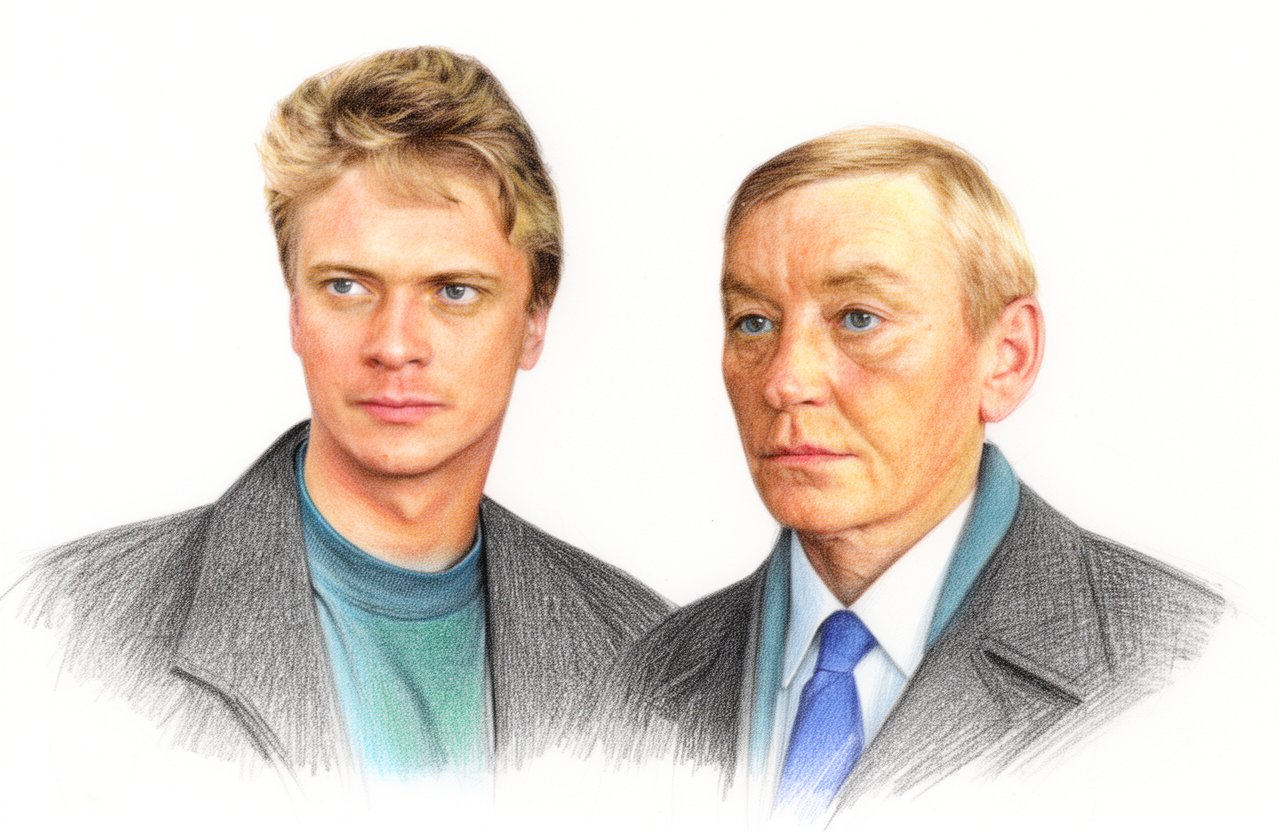
Detective Chief Inspector Jim Taggart
Mark McManus embodied the title character with a gruff, unshakeable authenticity that defined the series for its first decade. His DCI Jim Taggart was a pragmatic, often cynical detective rooted in the streets of Glasgow.
He operated with a world-weary intuition, frequently clashing with more by-the-book colleagues.
The performance avoided glamour, presenting a policeman burdened by the grim nature of his work yet doggedly committed to finding answers. McManus portrayed Taggart’s domestic life with wife Jean, played by Harriet Buchan, adding a layer of relatable normality.
This grounding made his professional tenacity more compelling.
His sudden death in 1994 presented a profound challenge to the production. The decision to continue the series under the Taggart name became a testament to the strength of the world and the supporting ensemble he helped establish.
McManus’s portrayal remains the foundational performance, setting a tone of gritty realism.
Detective Inspector Jackie Reid
Blythe Duff’s Jackie Reid represents one of the most significant evolutions in the series. Introduced as a Woman Police Constable in 1990, her character grew in prominence and rank over two decades, ultimately becoming a Detective Inspector.
This progression mirrored real career trajectories, offering a sustained point of view.
Reid brought a different energy to the investigations: meticulous, perceptive, and less burdened by the old-school cynicism of her predecessors. Duff’s performance balanced professional competence with a nuanced personal life, making Jackie a relatable anchor for audiences.
Her longevity provided crucial continuity.
As the cast changed around her, Jackie Reid became the connective tissue of the later series. Duff’s steady, intelligent presence ensured the show’s heart remained in Glasgow’s CID, proving the strength of the unit beyond any single individual, even one as iconic as Jim Taggart.
Notable Support and Guest Stars
The core team around Taggart provided essential dynamics. James MacPherson’s Michael Jardine, arriving in 1987, evolved from Detective Sergeant to DCI, often serving as Taggart’s principled foil.
Iain Anders’s Superintendent Jack “The Biscuit” McVitie offered bureaucratic obstruction and occasional comic relief from 1985.
Later leads included John Michie as the sharp DI Robbie Ross and Alex Norton, who brought a weathered authority as DCI Matt Burke in the 2000s. Colin McCredie’s DC Stuart Fraser added a younger, tech-savvy perspective.
Pathologist Dr Stephen Andrews, played by Robert Robertson, delivered forensic truths with dry wit.
Guest stars frequently elevated individual stories. Notable names like Isla Blair, Ken Stott, Diane Keen, and Annette Crosbie brought high-calibre performances to complex roles, ensuring the mysteries were driven by compelling character motivations as much as procedural detail.
Key Episodes & Defining Stories
Killer
The 1983 miniseries that started it all is essential viewing. It introduces Mark McManus’s DCI Jim Taggart and Neil Duncan’s DS Peter Livingstone investigating a series of stranglings.
The grim pattern of victims establishes the show’s comfort with dark subject matter from the outset.
Written by creator Glenn Chandler, it perfectly sets the template: a psychologically complex case rooted in Glasgow’s geography, contrasting Taggart’s abrasive methods with Livingstone’s idealism. The success of this feature-length production convinced Scottish Television and ITV to commission the ongoing series.
Fans remember it for McManus’s defining performance and the establishment of a morally ambiguous, realistic policing world. It’s the foundational text, demonstrating the potent blend of character, location, and grim puzzle that would sustain the show for decades.
Cold Blood
This 1987 New Year special, written by Glenn Chandler, is a masterclass in intricate plotting. It begins with what seems a straightforward crime of passion, a wife shooting her unfaithful husband in a public car park.
The investigation, led by Taggart and Jardine, quickly unravels when the post-mortem reveals a shocking twist.
Guest starring Diane Keen, the episode excels at misdirection, forcing a complete re-examination of the victim’s business life. It showcases the series at its most confident, weaving a complex web of motive and opportunity against large-scale Glasgow locations like the Scottish Exhibition and Conference Centre.
It matters because it cemented Taggart’s reputation for clever, twist-driven storytelling within British television. Fans cite it as a peak example of the show’s ability to deliver a satisfying, sophisticated whodunnit that plays fair with the audience while keeping them guessing until the end.
Hellfire
For a taste of Taggart’s willingness to engage with more macabre themes, Hellfire is a standout. The discovery of a burnt body in a disused railway tunnel leads Taggart and Michael Jardine into a world suggesting black magic and voodoo.
The atmosphere is thick with urban decay and superstition.
Directed by Alan Macmillan and featuring a memorable guest turn from Annette Crosbie, the episode brilliantly balances its sensational elements with grounded police work. The detectives must sift through occult symbolism to find a all-too-human motive, reflecting the show’s core belief in rationality.
Fans remember it for its distinctive, creepy ambiance and its demonstration that the series could venture into gothic territory without losing its procedural rigour. It’s a compelling example of how Taggart used Glasgow’s darker, older corners to frame its mysteries.
The World of Taggart
Taggart is Glasgow. The city is not merely a backdrop but a central character, shaping every investigation.
The series was filmed primarily on location, using real streets, tenements, and public buildings to create an authentic and unmistakable environment. The fictional Maryhill CID operated within the real Strathclyde Police force.
Stories moved from affluent suburbs to deprived housing schemes, along the River Clyde, and into the bustling city centre. This gave a comprehensive portrait of the city’s social fabric.
The frequent overcast skies and rain typical of western Scotland added a layer of gritty realism to the visual tone.
The use of local accents and dialect in the dialogue further cemented this sense of place. Glasgow’s identity—its humour, its tensions, its resilience—permeates every frame, making the setting as crucial to the show’s identity as any of the detectives who walked its streets.
Origin Story
Taggart began as a three-part miniseries titled “Killer,” written by Glenn Chandler for Scottish Television. It was broadcast on ITV in September 1983, introducing Detective Chief Inspector Jim Taggart, played by Mark McManus.
The success of this pilot led to the commissioning of an ongoing series, which began in July 1985.
Produced by Scottish Television in Glasgow for the ITV network, the show was filmed on location in the city, establishing its gritty aesthetic from the start. The iconic theme “No Mean City,” performed by Maggie Bell, became instantly synonymous with the series.
Creator Glenn Chandler wrote a significant number of the early scripts, setting its narrative tone.
Narrative Style & Tone
Taggart is a straightforward, serious police procedural focused on the investigation of murder. The style is that of a classic whodunnit, following detectives as they methodically assemble clues and interrogate suspects.
The plots are often complex, featuring graphic crime scenes and dark subject matter.
Character-driven subplots involving the detectives’ personal lives are woven through, but the perspective remains firmly with the police. The tone is gritty and dramatic, with intermittent humour arising from workplace exchanges.
Dialogue is naturalistic, featuring Glaswegian speech patterns, which reinforces the show’s powerful sense of place and authenticity.
How is Taggart remembered?
Taggart is remembered as an iconic, foundational piece of Scottish television and one of the UK’s longest-running crime dramas. Its catchphrase, “There’s been a murder,” delivered in a Glaswegian accent, entered popular culture.
The show is synonymous with a gritty, realistic portrayal of police work and with Glasgow itself as a compelling setting.
It maintained strong ratings for decades and was successfully exported worldwide. While the series continued after Mark McManus’s death, his original portrayal remains central to its legacy.
The show is celebrated for its intricate plotting, strong ensemble casts, and its role in proving the viability and appeal of high-quality drama production in Scotland.
Retrospectives and anniversary events highlight its enduring impact. For fans, Taggart represents a benchmark in British crime drama: intelligent, character-driven, and utterly authentic to its time and place, leaving a legacy that continues through repeats and streaming.
In Closing
From its beginnings with Jim Taggart to its evolution into a formidable ensemble piece, the series stands as a testament to powerful storytelling rooted deeply in its city. It remains a definitive chapter in the history of British television crime drama.