
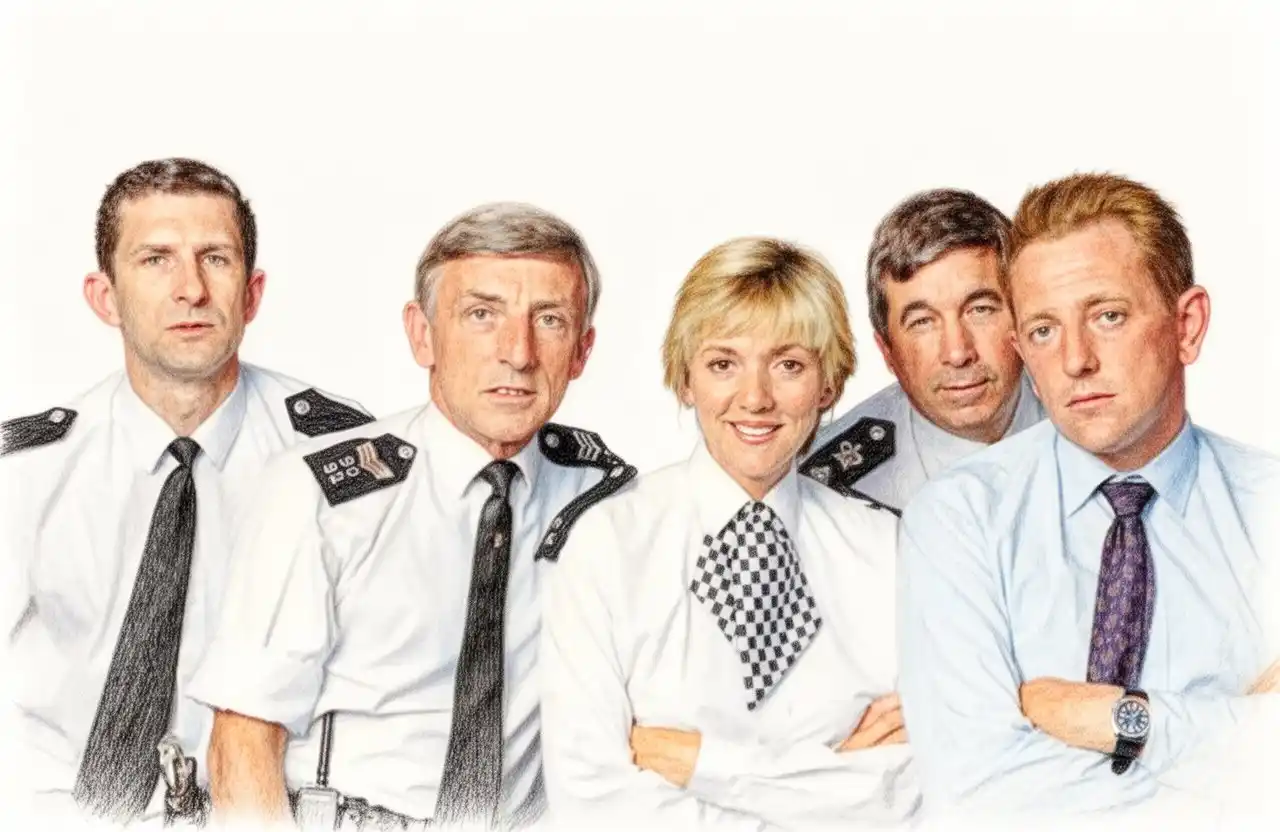
My Critique of The Bill
The Bill’s defining achievement was its authentic focus on routine policing, elevating procedural minutiae over glamour in a way most contemporaries shunned. Early half‑hour episodes delivered a relentless, single‑shift realism that grounded the drama in the unglamorous cadence of the job.
Yet as the years mounted, an increasing reliance on sensational, soap‑styled plotting diluted the original integrity and risked turning Sun Hill into a conveyor belt of shock. Against peers like The Shield or Life on Mars, it was less stylised but far more institutionally detailed, a yardstick for procedural verisimilitude despite narrative drift.
For modern viewers, it remains a vital artefact of British policing on television, offering a panoramic, unvarnished portrait of institutional life that still informs the genre.
Principal Characters & Performances
The heart of The Bill was its ensemble, a rotating roster of uniformed officers and detectives who felt like real people doing a difficult job. Their longevity and consistency gave the show its backbone, making Sun Hill station a believable workplace where careers progressed, personalities clashed, and the daily grind took its toll.
Jim Carver
Mark Wingett’s Jim Carver was the audience’s entry point, first appearing as the probationary constable in the 1983 pilot Woodentop. His journey from green PC to seasoned Detective Sergeant formed one of the series’ longest character arcs.
Carver was fundamentally decent but deeply human, prone to impulsiveness and moral complexity.
His career was a rollercoaster of promotions, demotions, and disciplinary hearings, reflecting the show’s interest in institutional politics. He navigated turbulent relationships, most notably with WPC Cathy Bradford, and faced profound personal crises, including a struggle with alcoholism.
Wingett’s grounded performance avoided cliché, presenting a copper who was neither a hero nor a rogue, but a flawed man trying to do right within a flawed system.
His presence for over two decades provided a crucial thread of continuity. Watching Carver evolve from the rookie who made a mistake on his first day to a weary, experienced DS was to watch the soul of The Bill mature.
June Ackland
As portrayed by Trudie Goodwin, WPC and later Sergeant June Ackland was the show’s moral compass and its longest-serving officer. From her first scene mentoring Jim Carver in Woodentop, Ackland represented professionalism, empathy, and resilience.
Goodwin brought a steely warmth to the role, balancing a nurturing instinct with formidable inner strength.
Her career trajectory broke ground, showcasing the challenges and prejudices faced by women in the police force during the era. Her personal life, including a celebrated romance and marriage to DI Jack Moffatt, was woven into the fabric of the station without defining her.
Ackland was the reliable constant, the officer others turned to, embodying the public service ethos at the show’s core. Goodwin’s 24-year tenure made her departure in 2007 feel like the end of an era for long-term fans.
Frank Burnside & Jack Meadows
The CID rooms at Sun Hill were dominated by two iconic, contrasting figures. Chris Ellison’s Detective Inspector Frank Burnside was a maverick, a bullish, often morally ambiguous investigator from the old school.
His methods were questionable, his temper legendary, but his results were undeniable. Burnside represented a certain gritty, confrontational style of policing that the series both scrutinized and dramatized effectively.
In contrast, Simon Rouse’s Detective Chief Inspector Jack Meadows, who arrived in 1990, was the calm, strategic counterpoint. A meticulous and deeply principled officer, Meadows provided stable leadership through countless crises.
His long-term relationship with DS Samantha Nixon added layers to his character without softening his professional demeanour. Rouse’s commanding performance made Meadows the trusted anchor of the CID, a figure of authority who earned respect through integrity rather than intimidation.
The Uniformed Backbone
The station’s heartbeat came from its uniformed sergeants and constables. Eric Richard’s Sergeant Bob Cryer was the archetypal, no-nonsense shift supervisor, a firm but fair presence from the very first series.
Graham Cole’s PC Tony Stamp, the dedicated area car driver, became a beloved fixture, representing the dependable, street-level copper.
Jeff Stewart’s PC Reg Hollis, the slightly awkward, procedure-obsessed station officer, provided both heart and humour. Figures like Chief Inspector Derek Conway, played with authoritative gravitas by Ben Roberts, completed the hierarchy, creating a fully realized workplace where every rank had a distinct voice and function.
Key Episodes & Defining Stories
Woodentop (1983)
This is where it all began. Broadcast as a one-off drama, Woodentop is essential viewing to understand The Bill’s DNA.
It follows probationer Jim Carver through his first day at Sun Hill, guided by WPC June Ackland. The handheld camera work and natural lighting create an immediate documentary feel, sticking rigidly to the police perspective.
Written by Geoff McQueen and directed by Peter Cregeen, the plot is deliberately mundane yet tense, involving a domestic dispute and the discovery of a dead body. The critical moment comes when Carver, frustrated, clips a troublesome youth round the ear—an act with immediate disciplinary repercussions.
This established the show’s core principle: actions have consequences, and policing is as much about navigating internal rules as it is about fighting crime. It’s a masterclass in grounded storytelling that convinced ITV to commission the series.
Cry Havoc (1991)
This half-hour episode from the show’s peak is a masterful exercise in sustained tension. A routine arrest on a bleak housing estate goes violently wrong when a suspect stabs Sergeant Peters and flees.
PC Stringer gives chase, losing radio contact as he pursues the man through the labyrinthine concrete walkways and stairwells.
Directed by Stuart Urban from a script by Geoff McQueen and Russell Lewis, the handheld camerawork becomes frantic, amplifying the claustrophobia and danger. The episode strips policing down to its most vulnerable: an isolated officer in hostile territory, relying on instinct and training.
It’s a raw, economical thriller that showcases The Bill’s ability to generate heart-in-mouth suspense from a simple, brutally plausible scenario, all within its trademark realistic aesthetic.
Fatal Consequences (2003)
Produced to celebrate the show’s 20th anniversary, this was a live broadcast event that demonstrated the confidence and skill of the production team. Centring on a hostage crisis involving DC Juliet Becker and PC Cathy Bradford, and a separate rooftop pursuit of a fugitive, the episode was a complex ballet of real-time action.
Written by Tom Needham and directed by Sylvie Boden, it featured guest actor Charles Dale as the unstable hostage-taker. The technical ambition was staggering, with live stunts, multi-camera switches between interior sets and exterior locations, and no margin for error.
Its successful execution was a triumphant statement. It proved The Bill was not just a factory for episodes, but a flagship drama capable of ambitious, high-wire television that honoured its legacy while pushing its format to the limit.
The World of The Bill
The action centred on the fictional Sun Hill police station, located in the equally fictional London borough of Canley, with a postal address placing it firmly in East London. This invented setting gave the writers freedom, but the environment felt authentically gritty.
Extensive location filming across South London boroughs like Merton provided the recognizable urban backdrop.
Sun Hill’s patch was a microcosm of inner-city life, encompassing grim housing estates, bustling high streets, dimly-lit pubs, and industrial yards. The station itself moved several times in reality, from original sites in Wapping to a long-term home in a converted warehouse in Merton, which housed the iconic standing sets.
This world wasn’t glamorous; it was workaday, sometimes bleak, and always busy. It was a place where paperwork piled up, the custody suite was constantly active, and the canteen gossip was as crucial as the briefing room update.
Origin Story
The Bill was born from a one-off television play. Geoff McQueen’s drama Woodentop, produced by Thames Television and broadcast on ITV in August 1983, introduced the handheld, documentary-style approach and the characters of Jim Carver and June Ackland.
Its critical success led ITV to commission an ongoing series.
The Bill proper began on 16 October 1984 with the episode “Funny Ol’ Business – Cops & Robbers”. Despite industrial disputes affecting the first series, the show found its footing, depicting the routine of uniformed officers and detectives with unprecedented naturalism.
Thames Television produced it until 2006, with Talkback Thames seeing it through to its conclusion in 2010.
Narrative Style & Tone
Initially, The Bill distinguished itself through a quasi-documentary style. Using handheld cameras and naturalistic lighting, it offered a “day in the life” feel, following a single shift from start to finish.
The rule that a Sun Hill officer must be in every scene locked the perspective firmly with the police.
Its tone was grounded and procedural, focusing on the mundane and the dramatic aspects of the job with equal weight. The shift to half-hour episodes in 1988 increased serialised elements, while a major revamp in 2002 embraced more soap-like storytelling.
Throughout its changes, the core remained a commitment to showing the impact of the job on the people who did it.
How is The Bill remembered?
The Bill is remembered as an institution. For nearly 27 years, it was a fixture of British television, renowned for its procedural authenticity and as a unparalleled training ground for actors.
Its cancellation in 2010 prompted widespread public and media reflection, marking the end of an era for ITV drama.
Fans and critics often split its legacy between the gritty, documentary-inspired early years and the more sensational, character-driven later seasons. Regardless, its reputation for realistic depictions of British policing endures.
It is cited by historians as a definitive police procedural, and its repeated appearances on digital channels confirm a lasting appetite for the lives and duties of Sun Hill’s officers.
In Closing
The Bill built a world that felt lived-in and a profession that felt real. Its legacy is the thousands of stories told from the front line, anchored by characters who became familiar faces over decades.
It was, quite simply, the job.