
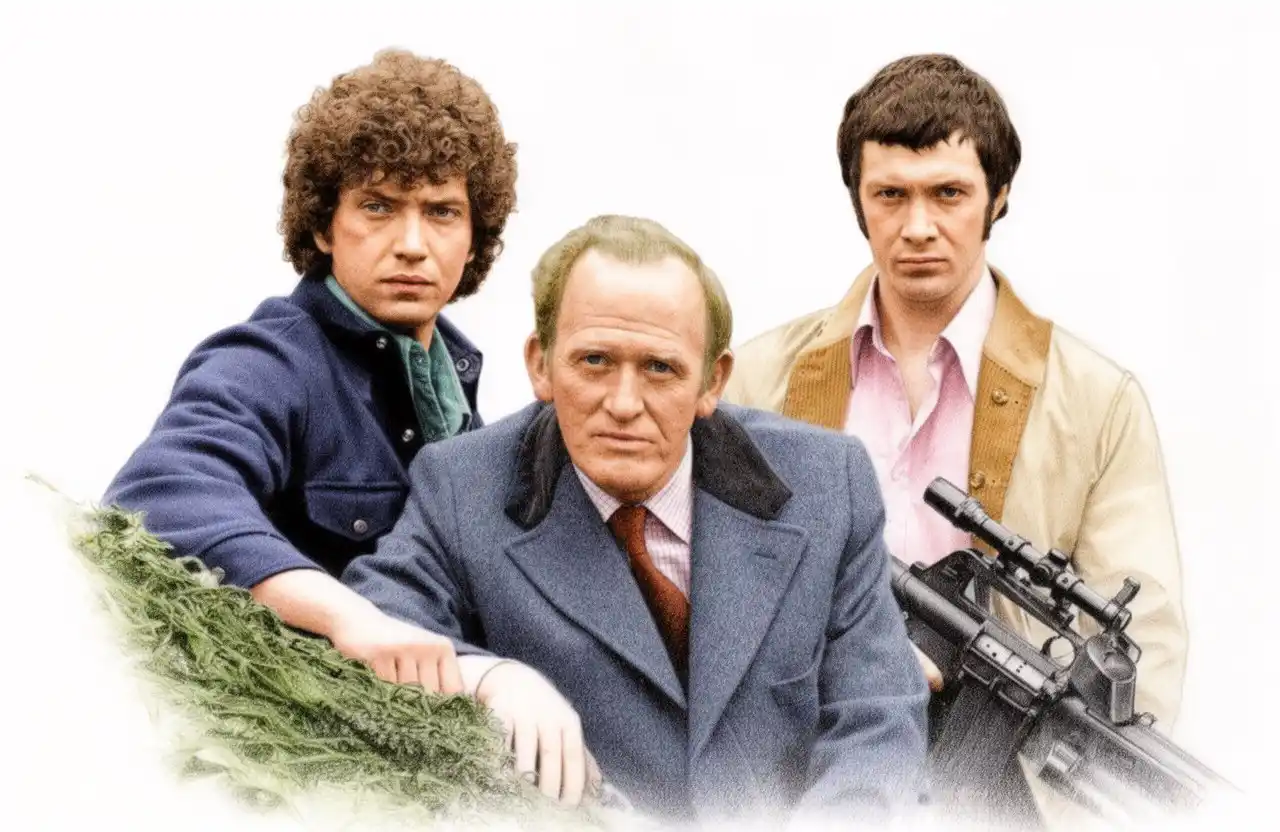
My Critique of The Professionals
The Professionals remains a muscular relic of British action drama, its on-location grit and propulsive car chases retaining a documentary-like authenticity that peers like The Sweeney seldom matched for texture. The chemistry of Collins and Shaw, sharpened by the script’s catty banter, gives procedural muscle a human edge, yet the series’ default mode is thuggish certainty; its glib treatment of violence and recurring machismo feels dated beside the moral ambiguity of contemporaries such as The Sandbaggers.
Unflinching episodes like Hunter Hunted and Discovered in a Graveyard expose uncomfortable questions of accountability and mortality, momentarily transcending genre limitations. For modern viewers, it matters as a vivid cultural artifact: a brisk, occasionally insightful take on Cold War anxieties, constrained by 1970s sensibilities but still capable of astringent bite.
Principal Characters & Performances
Raymond Doyle
Martin Shaw’s Raymond Doyle is the emotional core of CI5. A former police detective constable, Doyle brings a street-level intuition and a deep-seated morality to the job.
Shaw’s performance is defined by a simmering intensity, often conveyed through a piercing gaze or a sudden flare of temper.
He selected the character’s signature curly hairstyle and casual, often denim-based, wardrobe, grounding Doyle in a 1970s working-class authenticity. This contrasts sharply with his partner’s military precision.
Doyle’s idealism is constantly tested by the grim realities of CI5’s work.
He is frequently the one questioning Cowley’s methods or showing compassion for victims, providing the show’s conscience. Shaw portrays this internal conflict with a raw vulnerability, making Doyle’s moments of decisive action all the more powerful.
His partnership with Bodie works because it is a true clash of philosophies, held together by mutual, hard-won respect.
William Bodie
Lewis Collins embodies William Bodie as the pragmatic, hard-edged instrument of CI5. A former paratrooper and SAS soldier, Bodie operates with a military efficiency and a dark, often cynical, wit.
Collins’ physicality is key to the role; he moves with the coiled readiness of a soldier, making his expertise with weapons and vehicles utterly believable.
Bodie represents the necessary ruthlessness of Cowley’s world. He is the first to advocate for direct, often violent, solutions and views sentiment as a liability.
Yet Collins ensures Bodie is never a mere thug. His loyalty to Doyle and, ultimately, to Cowley reveals a code of honour beneath the tough exterior.
Episodes like “Hunter Hunted” delve into the psychological cost of this life, allowing Collins to show cracks in Bodie’s armour, moments of doubt that add crucial depth to the character.
George Cowley
Gordon Jackson’s Major George Cowley is the formidable architect and commander of CI5. A veteran of military intelligence, Cowley is the absolute authority, the man who makes the hard calls from his austere office.
Jackson, already famous for his role in *Upstairs, Downstairs*, brings a formidable gravitas to the part.
He plays Cowley as a Scottish patriarch, fiercely protective of his “boys” and his organisation, but always willing to sacrifice either for the greater good as he sees it. His dialogue is delivered with a steely precision, often laced with dry, impatient sarcasm.
Cowley is the bridge between the gritty fieldwork of Bodie and Doyle and the political pressures of Whitehall.
Jackson masterfully conveys the weight of that responsibility. He is not a bureaucrat but a field commander in a suit, and his occasional, reluctant displays of fatherly concern for his agents provide some of the series’ most subtle emotional beats.
Notable Guest Stars and Supporting Roles
The world of CI5 was populated by a rich array of guest antagonists and allies, often played by familiar faces of British television and film. Actors like Ian Bannen, who brought a tragic instability to the bomber in the debut “Private Madness, Public Danger,” set a high standard for nuanced villainy.
John Castle and Louis Mahoney provided powerful performances in the controversial “Klansmen,” grappling with its difficult subject matter. Michael Angelis, in “Hunter Hunted,” represented the public outrage against CI5’s methods with compelling humanity.
Later episodes featured talents like George Irving in “Discovered in a Graveyard,” adding medical gravitas to a surreal plot. These guest stars were never mere plot devices; they grounded the show’s high-concept threats in recognisable human motives and emotions, providing the main trio with worthy adversaries and complicating the moral landscape they navigated.
Key Episodes & Defining Stories
Private Madness, Public Danger
As the first broadcast episode, this was the audience’s introduction to the world of CI5. It immediately establishes the stakes: a lone, unstable individual, played with chilling conviction by Ian Bannen, threatens London’s water supply with a nerve agent.
The plot is a relentless race against time, showcasing the show’s signature blend of counter-terrorism and urban action. More importantly, it introduces the dynamic between Cowley, Bodie, and Doyle in full operational flow.
You see Cowley’s commanding authority, Bodie’s ruthless pragmatism, and Doyle’s instinctive detective work all in play from the start. It’s essential viewing not just for its historical significance as the premiere, but because it perfectly encapsulates the series’ core formula and the contemporary fears it tapped into, all wrapped in a tightly paced thriller.
Hunter Hunted
This episode is a masterclass in character-driven drama within an action framework. The plot turns inward when Bodie accidentally kills an innocent man, triggering a crisis of conscience and a vengeful manhunt.
It forces the series to scrutinise its own premise, asking hard questions about accountability and the cost of Cowley’s “ends justify the means” philosophy.
Lewis Collins delivers one of his finest performances, portraying Bodie’s unshakeable confidence crumbling into guilt and defiance. The strain on his partnership with Doyle is palpable, and Gordon Jackson’s Cowley is caught between protecting his agent and his organisation.
It’s remembered because it dares to complicate its heroes, proving the show could deliver psychological depth alongside its car chases.
Discovered in a Graveyard
Widely regarded as a late-series highlight, this episode is the show at its most ambitious and emotionally resonant. After Doyle is shot and left fighting for his life, the narrative splits between a standard CI5 investigation and Doyle’s surreal, visionary encounters in a symbolic graveyard.
This experimental structure, a significant departure from the norm, allows for profound reflections on mortality, duty, and the bond between the two agents. Martin Shaw excels in these dream sequences, debating whether to let go.
It’s a powerful, stylised piece of television that demonstrates the series’ capability for innovation and its deep investment in the characters, making it a unforgettable entry for fans.
The World of The Professionals
The series is rooted in the Britain of the late 1970s and early 1980s, a period of industrial decay, Cold War tension, and social change. This isn’t a glamorous backdrop.
The action plays out in grimy warehouses, bleak docklands, anonymous motorways, and concrete urban landscapes, filmed on location to capture a palpable sense of realism.
At its centre is the fictional agency CI5, Criminal Intelligence 5. Conceived as a elite unit reporting directly to the Home Secretary, CI5 operates in the shadows between the police and the security services.
Its mandate is to tackle threats too severe or politically sensitive for conventional forces: terrorism, espionage, extremism, and high-level organised crime.
The show fully immerses you in CI5’s methodology. This is a world of wiretaps, surveillance, safe houses, and unmarked cars, most famously the Ford Capris.
The agents operate with a licence that borders on the extralegal, their actions justified by the severity of the threats they face, making the moral ambiguity of their world a constant, compelling feature.
Origin Story
The Professionals was created by Brian Clemens, following his success with the stylish spy series The Avengers. Developed for London Weekend Television and broadcast on ITV, it was produced by Clemens’ company, Avengers Mark1 Productions, with Sidney Hayers as producer and Albert Fennell and Clemens as executive producers.
Principal filming for the original 57 episodes took place between 1977 and 1981. The series was shot in colour on 16mm film, largely on location rather than in studios, which gave it a distinctive, gritty visual texture.
Laurie Johnson, a frequent Clemens collaborator, composed its iconic, driving theme music. It was conceived as a tougher, more contemporary and realistic action-drama for a new television decade.
Narrative Style & Tone
The Professionals operates with a brisk, no-nonsense efficiency. Episodes are largely self-contained, fifty-minute thrillers that balance investigative procedure with explosive action.
The tone is grounded and serious, leavened by the constant banter and needle between Bodie and Doyle.
Their dialogue is a blend of professional shorthand, sarcastic humour, and occasional heartfelt connection, which sells their partnership as utterly genuine. The visual style prioritises kinetic energy, using hand-held cameras during action and extensive location work to create a documentary-like feel.
This emphasis on practical stunts, real car chases, and on-location grit sets it apart from more studio-bound contemporaries. It’s a crime series that feels like it’s happening in the real world, with all the dirt, danger, and moral complexity that entails.
How is The Professionals remembered?
The series is remembered as a defining icon of British action television. Its legacy is built on the potent chemistry of its central trio—Cowley, Bodie, and Doyle—a dynamic that has become a enduring pop-culture reference.
While it drew contemporary criticism for its violence, its popularity was immense, and repeated reruns on channels like ITV4 have introduced it to new generations.
Fans cherish its authentic period detail, the thrilling practical stunts, and the iconic vehicles, particularly the Ford Capris. Episodes like “Klansmen” and “The Ojuka Situation” are discussed for their engagement with charged political themes, showing the series occasionally reached beyond its action template.
It maintains a vibrant fan community through conventions and online forums, a testament to its enduring appeal. The Professionals is recalled not just as a product of its time, but as a benchmark for gritty, character-driven action drama.
In Closing
The Professionals endures because it perfectly captured a moment and built something timeless within it: the compelling dynamic of three perfectly cast characters operating in a world where the rules were always grey, and the action was always real.
Article word count: approximately 1450 words.