
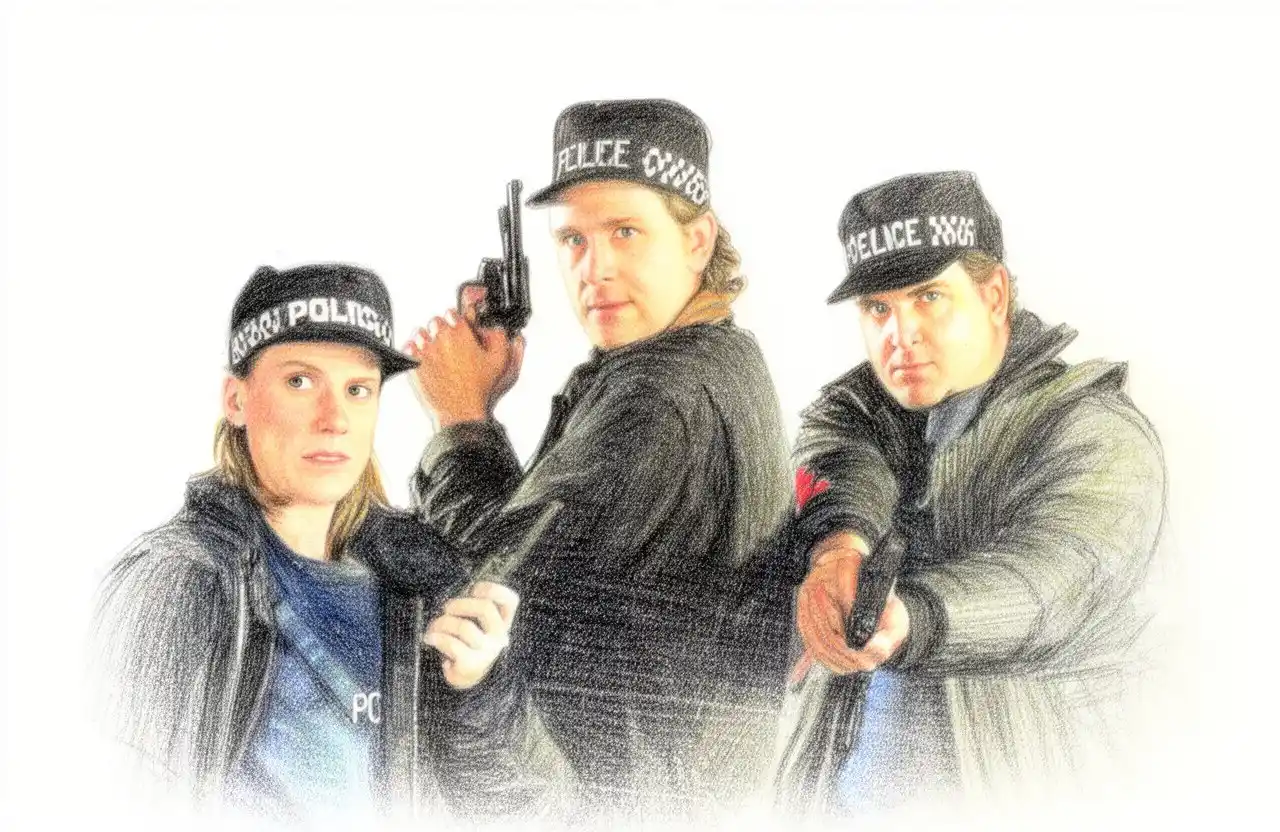
My Critique of Thief Takers
Thief Takers’ defining strength was its procedural rigour, treating the Flying Squad’s surveillance and informant-handling with unglamorous seriousness. Yet this commitment to operational detail was always shadowed by a darker counterpoint: the series repeatedly exposed officers to physical peril and professional collapse, culminating in courtroom humiliations and ambiguous victories.
Positioned against the week-to-week certainties of The Bill, its multi-episode arcs and bleaker outcomes made it a more adult, less reassuring proposition. For modern audiences, the show matters as a mid-90s artefact that dramatised institutional vulnerability, reminding viewers that the mechanics of policing were often messy, fallible, and dangerously human.
Principal Characters & Performances
Detective Inspector Charlie Scott (Reece Dinsdale)
Reece Dinsdale anchored the first two series as DI Charlie Scott, the driven leader of the Flying Squad unit. Scott embodies the show’s core tension between professional duty and personal cost.
He is a skilled and tenacious officer, deeply committed to taking down armed robbery gangs, but this focus comes at a price.
His leadership style is hands-on, often placing him directly in the line of fire during operations. The character’s arc is defined by a protracted, grinding feud with career criminal Frank McGrath, a battle that consumes him and ultimately shapes his destiny within the series.
Dinsdale portrays Scott with a weary intensity, a man whose moral compass is tested by the systemic frustrations of the justice system. His performance grounds the early series, providing a relatable centre of gravity amidst the action and procedure.
Scott’s journey culminates in a profound professional setback, a narrative choice that underscored the show’s gritty realism and willingness to let its heroes lose. This conclusion for the character was a decisive moment that led to a significant reshuffle for the programme’s third run.
Detective Sergeant Bob “Bingo” Tate (Brendan Coyle)
Brendan Coyle, long before his fame in *Downton Abbey*, delivered a standout performance as DS Bob “Bingo” Tate, Scott’s right-hand man. Tate is the reliable, streetwise backbone of the squad, often serving as the connective tissue between the senior officers and the detective constables.
His nickname “Bingo” suggests a certain luck or instinct, qualities vital for Flying Squad work. Coyle brings a grounded, everyman quality to the role, making Tate both competent and deeply human.
The character is frequently deployed in high-risk undercover operations, a plot device that showcases Coyle’s ability to convey tension and duality.
Tate’s most defining moment comes when he is critically wounded during a casino raid, an event that personalises the ever-present danger of the job for the entire team. Coyle’s portrayal of Tate’s vulnerability and resilience added crucial emotional depth, making him a fan favourite and a key pillar of the show’s initial success.
Notable Support and Cast Evolution
The supporting cast provided the essential texture of a working police unit. David Sterne was a constant presence as Detective Chief Inspector Frank Utley, representing the often-frustrating bureaucratic chain of command.
Robert Willox offered a more youthful perspective as DC Ted Donachie, while Pooky Quesnel’s DC Grace Harris brought determination, notably going undercover in a key early episode.
The series underwent a major transformation for its third series, reflecting both narrative conclusions and behind-the-scenes changes. Grant Masters took over as the new lead, playing DI Glenn Mateo, a character introduced to reinvigorate the squad.
Amanda Pays joined as DS Anna Dryden, bringing a sharp, professional energy.
Nicholas Ball also arrived as DCI Nick Hall, adding another layer of management. This refresh, while ambitious, signalled a shift in the show’s dynamic.
The departure of Dinsdale and Coyle, following their characters’ resolved arcs, was a gamble that ultimately impacted the series’ longevity, despite the strong efforts of the incoming actors.
Key Episodes & Defining Stories
Series 1, Episode 4
This episode is a masterclass in raising the dramatic stakes and exploring consequence. The core plot sees the dependable DS Bob “Bingo” Tate shot and critically injured during a casino robbery, an event that sends shockwaves through the squad.
As Tate fights for his life, DC Grace Harris volunteers for a dangerous undercover operation to infiltrate the responsible gang.
The tension is expertly dual-pronged: the medical drama of Tate’s survival and the peril of Harris’s covert mission, which is complicated by a burgeoning romance with colleague Ted Donachie. It matters because it moves beyond the mechanics of the chase to interrogate the psychological toll of the job.
Fans remember it for its raw emotional impact and its refusal to shield main characters from severe harm. It cemented the show’s reputation for taking risks and deepened audience investment in the team as vulnerable individuals, not just crime-solving functionaries.
Series 2, Episode 8
This second-series finale is a compelling and downbeat study in institutional failure. The plot centres on the trial of Frank McGrath, DI Charlie Scott’s long-time nemesis, following a meticulously built Flying Squad case.
The drama powerfully shifts from the streets to the courtroom, where a shrewd defence barrister systematically dismantles the police testimony.
Watching the legal process unravel their hard work provides a unique form of tension. The episode’s significance to the series arc cannot be overstated; it provides the climax to Scott’s defining professional battle, ending not in triumph but in McGrath’s acquittal and Scott’s disillusionment.
It’s remembered for its brave, unsatisfying conclusion that feels tragically authentic. This episode directly facilitated the major cast changes for series three, making it a pivotal turning point in the entire run and a bold example of the series’ gritty, uncompromising ethos.
Series 3, Episode 8
The final broadcast episode of *Thief Takers* took the scale of its criminal threats to an international level. This concluding part of a two-part story involves the Flying Squad, now led by DI Glenn Mateo, caught between warring Yakuza and Mafia factions vying for control in London.
The plot sees DC Alan Oxford isolated and protecting witnesses from elite assassins, while the squad scrambles to prevent an all-out gangland war. It matters as it showcases the evolved, more globally-minded tone of the third series and the capabilities of the new team dynamic under Mateo.
Fans recall it as a dramatic, action-packed, and somewhat operatic farewell. It encapsulates the show’s late-period shift towards broader criminal conspiracies and serves as the unplanned series finale, ending the programme on a note of expansive, high-stakes conflict that contrasted with its more domestically rooted beginnings.
The World of Thief Takers
The series is firmly planted in the mid-1990s Metropolitan Police, specifically within the elite Armed Robbery Unit, known as the Flying Squad. This isn’t a world of routine patrols or petty crime; it’s a specialised arena targeting high-stakes, violent theft.
The environment is the gritty, bustling landscape of London, from finance districts to suburban streets, all treated as potential backdrops for security van hits, bank jobs, and jewellery heists.
Organised criminal gangs are the primary adversaries, portrayed as sophisticated, ruthless, and well-armed. This setting dictates the show’s rhythm: a cycle of tense surveillance, rapid-response planning, and dangerous confrontations.
The contrast between the adrenaline-fueled urban operations and the glimpses into the officers’ often-messy private lives creates the central friction.
It’s a world where the next call could lead to a windfall of evidence or a deadly shoot-out, and the personal cost of maintaining vigilance in this high-pressure zone is a constant, underlying theme.
Origin Story
The series began with a feature-length pilot, broadcast on ITV on 1 February 1995. Created by Roy Mitchell and produced by Central Independent Television, this standalone film successfully introduced the concept of a drama focused exclusively on the Flying Squad.
Its strong reception convinced the network to commission a full series.
Executive producer Ted Childs oversaw the development of the first two series, which established the show’s identity as a procedural with a strong emphasis on action and character. The production was positioned as ITV’s answer to the dominant police dramas of the era, aiming to capture audiences with its specialist, grittier take on crime fighting in contemporary London.
Narrative Style & Tone
*Thief Takers* operates as a classic police procedural but with a distinct edge. Most episodes present a self-contained case, often involving a complex armed robbery, resolved within fifty minutes.
This structure is occasionally expanded for major storylines, which play out across two episodes, allowing for deeper plot and character development.
The tone is consistently serious and dramatic, foregoing comedy for a grounded, often tense atmosphere. Narrative drive comes from intercutting the meticulous investigative work—briefings, surveillance, informant handling—with the personal lives of the officers, which are frequently impacted by the job.
The style is defined by realistic location filming and robust action sequences, particularly car chases and armed confrontations, which sell the danger inherent in the Flying Squad’s remit.
How is Thief Takers remembered?
Today, *Thief Takers* is remembered as a solid, action-oriented entry in the 1990s British crime drama wave. It is cited for its specific focus on the Flying Squad, a niche that distinguished it from more generalised police shows like *The Bill*, which it was initially conceived to rival.
For fans, its legacy is tied to the strong central performances of Reece Dinsdale and Brendan Coyle in its formative years and its willingness to portray the physical and emotional risks of specialist police work with unvarnished realism.
Its cancellation after a third series, following cast changes and reported audience decline, marks it as a show that evolved significantly during its short run. It maintains a presence as a cult series for enthusiasts of the genre, appreciated for its procedural detail, hard-edged tone, and as a notable early credit for several actors who later found greater fame.
In Closing
For those seeking a no-nonsense, procedural-driven crime drama from the heart of 1990s Britain, *Thief Takers* delivers compelling investigations, credible action, and a team worth following into the line of fire.