My Critique of Tinker Tailor Soldier Spy
Alec Guinness’s Smiley anchors a drama of glacial intensity, foregrounding meticulous procedure over explosive action. The series’ anti-glamour aesthetic and patient exposition set it apart from flashier contemporaries like The Professionals.
Its chiaroscuro visuals, muted score and claustrophobic interiors evoke a bureaucratic Cold War without nostalgia. A central constraint is the deliberate pacing, which can feel ponderous to modern viewers.
Ian Richardson’s Haydon crystallises the corrosive theme of betrayal. This remains a pinnacle of British espionage television, rewarding the patient with unmatched psychological rigour and moral complexity.
Principal Characters & Performances
George Smiley
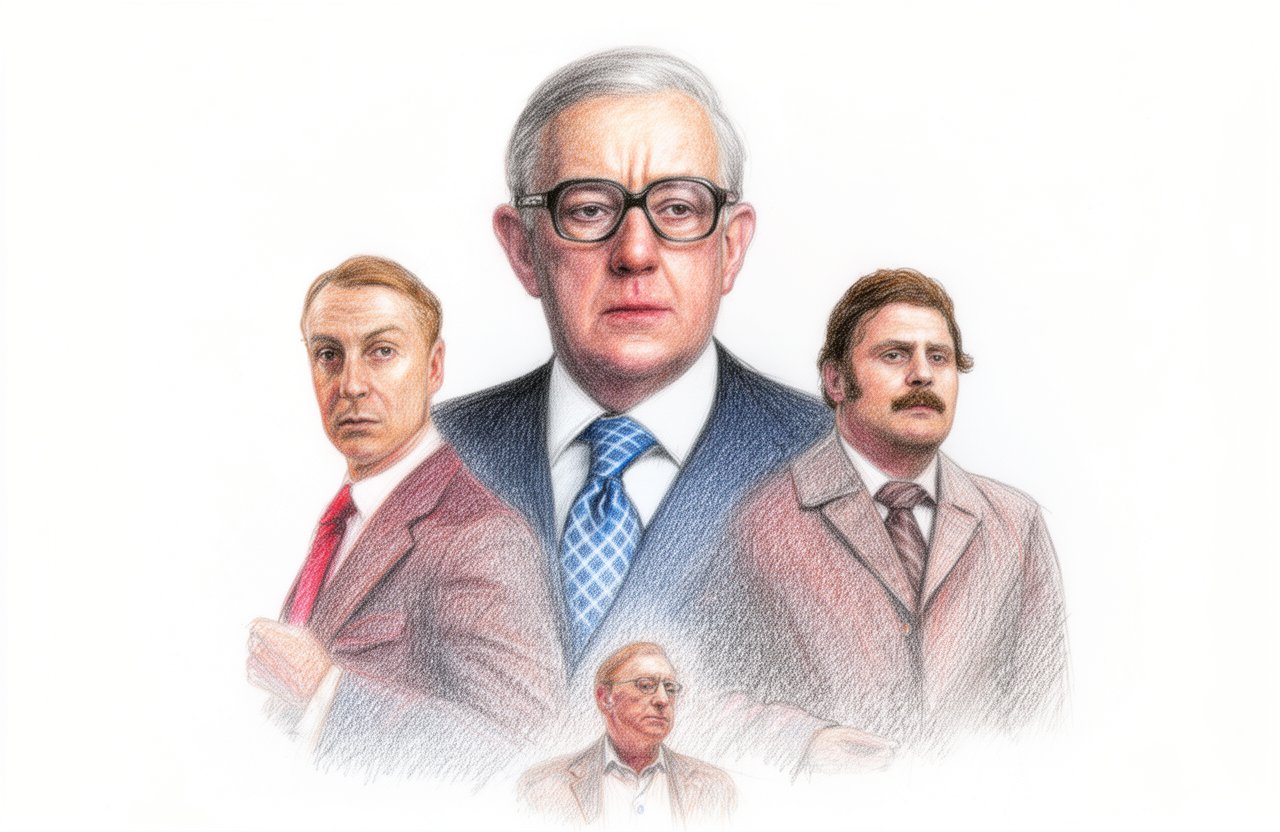
Alec Guinness’s performance as George Smiley is the quiet, beating heart of the entire series. He is not a spy of action but of thought, a man who solves treason through patient recollection and meticulous paperwork.
Guinness embodies Smiley’s profound weariness, his owlish gaze magnified by thick spectacles, suggesting a mind constantly sifting through layers of deceit.
His movements are deliberate, his voice a soft, measured instrument. There is no grandstanding, only the slow, painful reassembly of a shattered service and his own personal betrayals.
The genius of Guinness’s portrayal lies in its profound stillness. He commands the screen not by doing, but by thinking, making the audience lean in to catch every nuance, every slight shift in his expression as another piece of the puzzle clicks into place.
This interpretation defined the character for a generation, earning Guinness a British Academy Television Award for Best Actor. It is a masterclass in understatement, proving that the most powerful tension comes not from chases, but from a man in a quiet room, thinking.
Bill Haydon
Ian Richardson plays Bill Haydon, the charming, aristocratic star of the Circus’s intelligence wing. Richardson brings a languid, almost feline grace to the role, making Haydon’s intellect and cultural superiority palpable.
He is the epitome of the establishment insider, a man who moves through clubs and corridors with effortless authority.
This makes the eventual revelation of his betrayal all the more devastating. Richardson’s performance is a tightrope walk of ambiguity.
He lets you see why Smiley, and everyone else, admired and trusted him, which deepens the sting of his treachery. His final confrontation with Smiley is a highlight, where Richardson’s cool, unrepentant arrogance meets Guinness’s subdued, forensic disappointment.
It is a clash of ideologies and personal wounds, delivered not with shouts, but with chillingly polite conversation. Richardson makes Haydon’s betrayal feel not just professional, but a deeply personal violation of every bond within the service.
Peter Guillam, Jim Prideaux, and Karla
Michael Jayston’s Peter Guillam serves as Smiley’s operational right arm and the audience’s anchor within the Circus. Jayston portrays him as capable, loyal, and increasingly burdened by the moral compromises of the hunt.
His tense, watchful performance shows a man straining to hold his professional facade together under immense pressure.
Ian Bannen delivers a haunting, wounded turn as Jim Prideaux. As the field agent shot and betrayed during Operation Testify, Bannen embodies physical and psychological trauma.
His scenes recounting the disaster are raw and powerful, grounding the bureaucratic molehunt in visceral, human cost.
In a brief but unforgettable silent appearance, Patrick Stewart plays Karla, Smiley’s Soviet opposite. Stewart says nothing, his performance conveyed entirely through stillness, a penetrating stare, and the simple, telling act of pocketing Smiley’s lighter.
It is a masterstroke of minimalism that makes the unseen spymaster a looming, omnipresent threat.
The ensemble is rounded out by superb actors like Bernard Hepton as the slippery Toby Esterhase, Hywel Bennett as the desperate Ricki Tarr, and Anthony Bate as the officious Oliver Lacon. Each performance is a finely tuned piece in a complex machine of deception.
Key Episodes & Defining Stories
Return to the Circus
The opening episode is a masterclass in setting a tone. It introduces us not to action, but to aftermath.
Alec Guinness’s George Smiley, retired and adrift, is summoned by civil servant Oliver Lacon. The mission is vague, the authority deniable.
We learn through careful dialogue and flashbacks about the failed Operation Testify and the ousting of Control.
The episode immerses you in the world of the Circus, a place of muted office politics and whispered suspicions. It establishes the methodical pace that defines the series.
Fans remember it for how it confidently asks the audience to listen closely, to pay attention to glances and hesitations. It’s the essential foundation, showing Smiley beginning his patient, lonely work of reassembling the truth from fragments of memory and filed reports.
How It All Fits Together
This episode contains one of the series’ most iconic sequences: Smiley’s recounting of his only meeting with Karla. In a lengthy flashback, Patrick Stewart, in a wordless performance, plays the captured Soviet spymaster in a Delhi jail.
Smiley’s attempt to recruit him fails, culminating in Karla silently taking Smiley’s engraved lighter.
This story, told to Peter Guillam, is more than a flashback. It explains the personal, philosophical war at the heart of the professional one.
It shows why Karla targets Smiley, and why the molehunt matters so deeply. The episode weaves this past failure with present pressure on Guillam and Ricki Tarr.
It’s remembered for that brilliant, tense stillness of Stewart’s performance and for making the enemy a tangible, brilliant presence.
Tinker Tailor
The emotional core of the investigation is laid bare in this episode. Smiley travels to see Jim Prideaux, now a wounded schoolteacher played with heartbreaking rawness by Ian Bannen.
Prideaux’s account of Operation Testify—the waiting, the betrayal, the shooting—transforms the molehunt from an intellectual puzzle into a personal tragedy.
We see the brutal cost of the treason in Prideaux’s physical and psychological scars. The episode shifts from London’s grey offices to the bleak, recalled landscapes of the failed mission, grounding the conspiracy in real blood and suffering.
Fans remember it for Bannen’s devastating performance and for the moment the investigation stops being about documents and starts being about people. It’s the human wreckage that fuels Smiley’s quiet resolve.
The World of Tinker Tailor Soldier Spy
The series paints a meticulously detailed portrait of early 1970s Britain, a world caught in a grey, weary Cold War. The action unfolds in drab government offices, modest London flats, and safe houses that feel terminally temporary.
The Circus headquarters, filmed in actual BBC offices, feels authentically bureaucratic, a place of filing cabinets and quiet desperation rather than high-tech glamour.
Locations like a prep school in Gloucestershire and the streets of Glasgow, standing in for Czechoslovakia, add to the sense of a small, interconnected world. This is a Britain of fading prestige, where the intelligence service is riddled with class tensions and institutional rivalry.
The environment is a character itself—shadowy, claustrophobic, and utterly convincing. It’s a world where betrayal happens not in exotic locales, but over a drink in a club or a conversation in a shabby room.
Origin Story
The television serial was a 1979 BBC adaptation of John le Carré’s 1974 novel. Produced by Jonathan Powell for BBC Two, it was directed by John Irvin with scripts by Arthur Hopcraft.
The production aimed for a faithful, atmospheric translation of the book’s complex plot. Filming took place in London, Oxford, Glasgow, and at Bredon School, using BBC offices to stand in for the Circus.
The now-iconic title sequence of Russian dolls, designed by Douglas Burd, perfectly captured the theme of layered deception. Geoffrey Burgon composed the memorable, mournful trumpet theme.
From its start, the production was built around Alec Guinness’s central performance, seeking to capture the novel’s psychological depth and procedural realism for television.
Narrative Style & Tone
The series moves with a deliberate, methodical pace that mirrors Smiley’s own investigation. It is dialog-driven, relying on conversations, interrogations, and internal memos to advance the plot.
Action is minimal; tension derives from psychological nuance and the slow uncovering of truth. The visual style is muted, favouring shadowy interiors and overcast exteriors.
Frequent flashbacks are seamlessly woven into the narrative, revealing past events that piece together the present mystery. The tone is consistently sombre, introspective, and morally ambiguous.
There are no clear heroes, only compromised individuals working in a morally murky profession. The series demands attention, rewarding viewers with a rich, layered, and intellectually satisfying experience.
How is Tinker Tailor Soldier Spy remembered?
It is remembered as a landmark of British television drama and the definitive screen interpretation of le Carré’s work. Upon broadcast, it was met with widespread critical acclaim, particularly for Alec Guinness’s performance, which is still cited as a benchmark for television acting.
The series set a new standard for the espionage genre, prioritizing tradecraft, psychology, and bureaucratic realism over action and gadgetry.
Its influence can be seen in decades of slower-burn, character-driven thrillers that followed. John le Carré himself considered it his favourite adaptation.
Retrospectively, it is celebrated for its unwavering commitment to its own sophisticated, demanding pace and its peerless ensemble cast. It remains a touchstone, a series that proves the greatest suspense is often found in the quietest moments.
In Closing
Tinker Tailor Soldier Spy is more than a thriller; it is a profound study of betrayal, loyalty, and the cost of a life lived in the shadows. Its power endures, a masterful and essential piece of television storytelling.