My Critique of Widows
Widows distinguishes itself by relocating the heist to the domestic aftermath, crediting its women with logistical intelligence rather than spectacle. Ann Mitchell’s commanding Dolly anchors the ensemble, but the writing never flinches from the colder calculus of grief and opportunism.
Its 1980s London milieu, shadowed by surveillance and rival gangs, feels leaner than contemporaries like The Sweeney; procedural grit yields to procedural compromise. Compared with later female-led dramas, the series is less polished and more austere, yet its procedural rigor and moral ambiguity remain bracing.
For modern viewers, it matters as a blueprint for character-first crime storytelling, a BAFTA-nominated precursor to Prime Suspect whose frank depiction of women orchestrating violence still resists nostalgia.
Principal Characters & Performances
Dolly Rawlins
At the absolute centre of Widows stands Dolly Rawlins, brought to life with formidable intelligence and steely resolve by Ann Mitchell. Dolly is not simply a grieving widow; she is a strategist, a leader, and the show’s undeniable engine.
When her husband Harry’s criminal empire collapses, Dolly discovers his meticulous plans. Instead of walking away, she seizes the ledger, recognising it as both a threat and an opportunity.
Mitchell’s performance masterfully balances cold calculation with flickers of vulnerability. Dolly organises the heist with military precision, manipulating friends and foes alike.
Yet her grief and rage are palpable, driving her every move. She transforms from a gangster’s wife into the gangster herself, a journey that defines the series.
Her leadership of the other women is pragmatic, sometimes harsh, but always focused on survival. Mitchell ensures Dolly is never a caricature of toughness.
She is a complex woman navigating a brutal, male-dominated world on her own terms, making her one of British television’s most iconic and enduring characters.
Shirley Miller and Linda Perelli
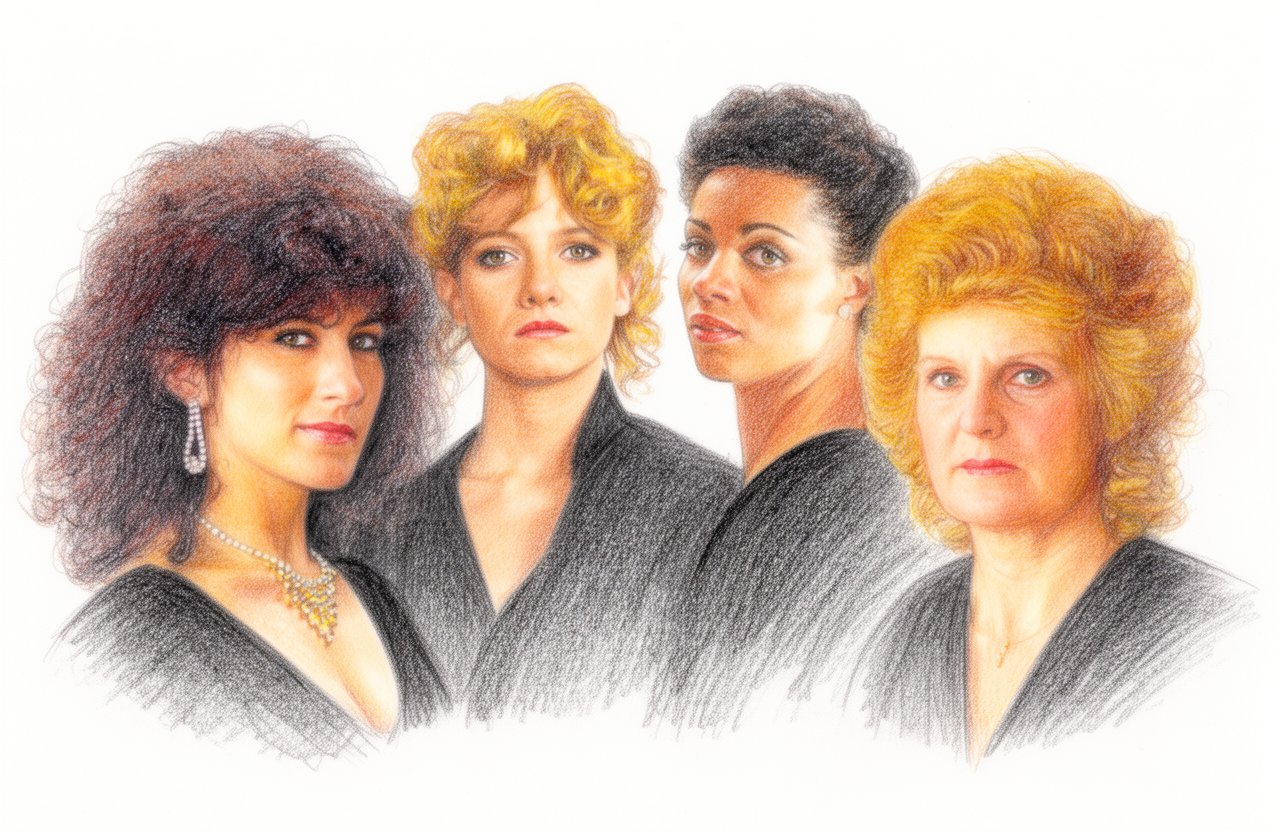
Fiona Hendley’s Shirley Miller and Maureen O’Farrell’s Linda Perelli form the core of Dolly’s reluctant crew. They are not natural criminals, and their journeys provide the series’ emotional heartbeat.
Shirley is younger, more visibly terrified, and initially the most resistant. Hendley portrays her fear and gradual hardening with raw authenticity.
Her relationship with her mother adds a layer of domestic tension, highlighting the dual lives the women are forced to lead. Shirley’s arc is about finding a spine she never knew she had.
Linda, portrayed by O’Farrell, is perhaps the most tragic figure. Her grief is profound, and her involvement is fueled by a desperate need for security and a twisted loyalty to her dead husband’s world.
She often seems on the edge of breaking, making her moments of courage all the more significant. Together, Shirley and Linda represent the ordinary women thrust into extraordinary, dangerous circumstances.
Their performances ground the high-stakes plot in relatable human emotion, making the heist’s stakes feel personal, not just financial.
Notable Support and Guest Stars
The criminal and police worlds surrounding the widows are populated by a roster of superb character actors. Maurice O’Connell is chilling as Harry Rawlins, a spectral presence whose legacy and eventual return haunt the entire narrative.
On the law side, David Calder brings a dogged, world-weary intensity to Detective Inspector George Resnick. Paul Jesson, as his colleague DS Alec Fuller, provides a contrasting, more procedural presence.
The role of Bella O’Reilly, the fourth widow recruited for her driving skills, was initially played with vibrant energy by Eva Mottley in the first series. Following Mottley’s departure, Debby Bishop assumed the role for the second series, maintaining the character’s crucial role in the team.
Guest stars like George Costigan and Jim Carter appear as rival gangsters, fleshing out the threatening London underworld. Kate Williams, as the nosy neighbour Audrey Withey, adds a layer of paranoia and domestic surveillance.
This ensemble creates a fully realised ecosystem of pressure, where every interaction carries weight and danger, brilliantly supporting the central quartet’s performances.
Key Episodes & Defining Stories
Widows: Episode 1
The series begins not with the women, but with their husbands’ botched robbery in the Kingsway Tunnel. This explosive prologue establishes the stakes immediately.
We then meet Dolly, Linda, and Shirley in the raw aftermath of their loss.
The genius of this opener lies in its pivot. Dolly’s discovery of Harry’s ledger transforms the story from a police procedural about a heist gone wrong into a heist thriller about to begin.
Directed by Ian Toynton or Paul Annett, the episode efficiently introduces Detective Inspector Resnick and the rival Fisher brothers, creating a pincer movement of pressure on Dolly. It’s the blueprint for everything that follows: grief weaponised into strategy, domestic spaces turned into war rooms.
Fans remember it for laying the foundation of Lynda La Plante’s masterful premise, proving from the first hour that the most dangerous person in the room might be the one everyone underestimates.
Widows: Episode 5
This is the payoff. After four episodes of meticulous planning, driving practice, and nerve-wracking preparation, the widows execute their raid.
The tension is masterfully sustained by cross-cutting between the robbery itself and a rival gang closing in on Dolly’s empty house.
The direction focuses on the mechanics and the psychology: the women using their perceived innocence as the ultimate disguise, the precision of their timing, the sheer adrenaline of the act.
It’s a landmark piece of television for placing a female ensemble at the heart of a genre sequence traditionally dominated by men. The episode validates Dolly’s leadership and the crew’s competence, delivering the core promise of the series in a taut, thrilling hour.
It’s remembered as the moment Widows stopped being a ‘what if’ and became a stunning ‘how they did it’.
Widows: Episode 6
The first series finale is a masterclass in escalating tension and setting up a future conflict. With part of the team already in Rio, Dolly and Shirley enact a clever decoy plan to escape London, showcasing their continued ingenuity under police surveillance.
The episode’s seismic shock is the return of Harry Rawlins, revealed to have survived the opening explosion. His reappearance at Dolly’s home, coinciding with an attack on Resnick, throws the entire success of the heist into jeopardy.
It transforms the narrative from a closed story of revenge and survival into an ongoing saga of betrayal and pursuit. The final sequences at the airport, with Dolly improvising to bypass customs, solidify her as a cool-headed tactician.
Fans recall this episode for its brilliant cliffhanger that demanded a second series, proving the story of these women was far from over.
The World of Widows
The world of Widows is early 1980s London, rendered in a palette of gritty realism. This isn’t a glamorous metropolis, but a city of working-class neighbourhoods, smoky pubs, and drab police stations.
The environments are functional and often oppressive.
Dolly’s house becomes the series’ nerve centre, a domestic space paradoxically filled with stolen cash and robbery plans. The contrast is key: the mundane details of tea and gossip sit alongside discussions of firearms and getaway routes.
The criminal underworld is a constant, threatening presence, populated by figures like the Fisher brothers who view Harry’s ledger as their rightful property. The police, led by the tenacious Resnick, provide a parallel pressure, their investigation a slow-burn threat.
This world expands from London to the sun-drenched escape of Rio, only to contract back to the UK’s rain-soaked streets for the second series. The geography always serves the psychology, reflecting the women’s shifting states of freedom and entrapment.
Origin Story
Widows was created and written by Lynda La Plante and produced by Euston Films for Thames Television. Commissioned by ITV, the first series was broadcast beginning in March 1983, with the legendary Verity Lambert serving as executive producer.
It was filmed on location in London and across the UK, contributing to its authentic, grounded feel. The series was structured as two six-part serials, with the first airing in 1983 and the second, often called Widows 2, following in 1985.
Each episode ran for approximately fifty minutes, allowing for deep, character-driven storytelling within a primetime crime drama slot. This format provided the space for La Plante’s intricate plotting and complex character development to flourish.
Narrative Style & Tone
Widows is a serialised, character-driven crime drama. Its tone is consistently gritty and suspenseful, prioritising psychological tension over graphic violence.
The narrative cross-cuts deftly between the planning widows, the investigating police, and the competing gangsters, building a comprehensive picture of the escalating situation.
The dialogue is naturalistic, full of the accents and slang of its time and place. The style is realistic, typical of quality British drama of the era, with a focus on process.
We see the heist being planned in detail, the driving being practiced, the logistics being worked out.
This procedural element, balanced with the domestic and emotional lives of the women, gives the series its unique texture. It’s a thriller that cares as much about the weight of a stolen glance as the weight of stolen money.
How is Widows remembered?
Widows is rightly remembered as a classic of 1980s British television and a landmark in crime drama. Its most celebrated innovation was placing four ordinary women at the centre of a high-stakes heist narrative, a concept that felt radical at the time.
The series earned a BAFTA nomination for Best Drama Series in 1984, signalling immediate critical recognition. Ann Mitchell’s performance as Dolly Rawlins is consistently highlighted as a masterclass in strength and complexity.
Historically, it is cited as the major breakthrough for writer Lynda La Plante, paving the way for her later work like Prime Suspect. The show is also noted as a significant production from executive producer Verity Lambert.
Decades after its broadcast, it remains in circulation through repeats and home video releases, its reputation secured as a smart, tense, and character-rich saga that redefined who could be the protagonist of a crime story.
In Closing
Widows endures because it is more than a clever premise. It is a gripping story of transformation, resilience, and cunning, anchored by phenomenal performances and sharp, suspenseful writing.
It remains essential viewing.