My Critique of Waking The Dead
Waking the Dead distinguished itself through a rigorous dual-layered structure, marrying meticulous forensic re-examination with psychological profiling to interrogate institutional failures. Its defining strength lay in Trevor Eve’s flinty Boyd, whose relentless pursuit of truth exposed systemic complacency, yet the series could be over-reliant on its formulaic two-part arcs.
Unlike contemporaries such as Life on Mars, its dark, desaturated aesthetic and ethical austerity felt less stylish but intellectually bracing, prioritising procedural rigour over nostalgic flair. For modern viewers, the show’s trenchant critique of police corruption and historical cover-ups remains unsettlingly prescient, though its unvarying solemnity and gender politics now feel rigorously dated.
Ultimately, it matters as a foundational text that legitimised the long-form cold case drama on British primetime, proving complex, serialized inquiry could command audiences without supernatural embellishment.
Principal Characters & Performances
Detective Superintendent Peter Boyd (Trevor Eve)
At the heart of the cold case unit is Peter Boyd, a detective defined by a volatile mix of brilliance and barely-contained rage. Trevor Eve’s performance never lets you forget the personal tragedy driving him: the unresolved death of his son, Luke.
This loss fuels his obsessive commitment to the forgotten victims of cold cases, but it also makes him a maverick, constantly at odds with his superiors. Boyd’s methods are confrontational, often relying on explosive interrogation-room tactics to shatter suspects’ lies.
Eve portrays him as a man whose professional dedication is both his salvation and his curse, weathering personal betrayals and institutional hostility across nine series. His journey from a lone wolf in the pilot to a leader whose team becomes a surrogate family forms the series’ emotional backbone.
Dr Grace Foley (Sue Johnston)
Providing the essential counterbalance to Boyd’s fire is Dr Grace Foley, the unit’s psychological profiler. Sue Johnston brings a grounded, compassionate intelligence to the role, making Grace the team’s moral centre and emotional barometer.
Her expertise lies in understanding the ‘why’ of a crime, constructing behavioural profiles that guide the investigation into the physical evidence. She frequently acts as Boyd’s conscience, challenging his impulsivity and forcing him to consider the human cost of his actions.
Johnston’s nuanced performance earned a Crime Thriller Award nomination, a testament to her character’s vital role. Grace represents the show’s commitment to exploring the psychological dimensions of crime, proving that solving a case requires understanding the minds involved, both criminal and victim.
The Investigative Team & Notable Guests
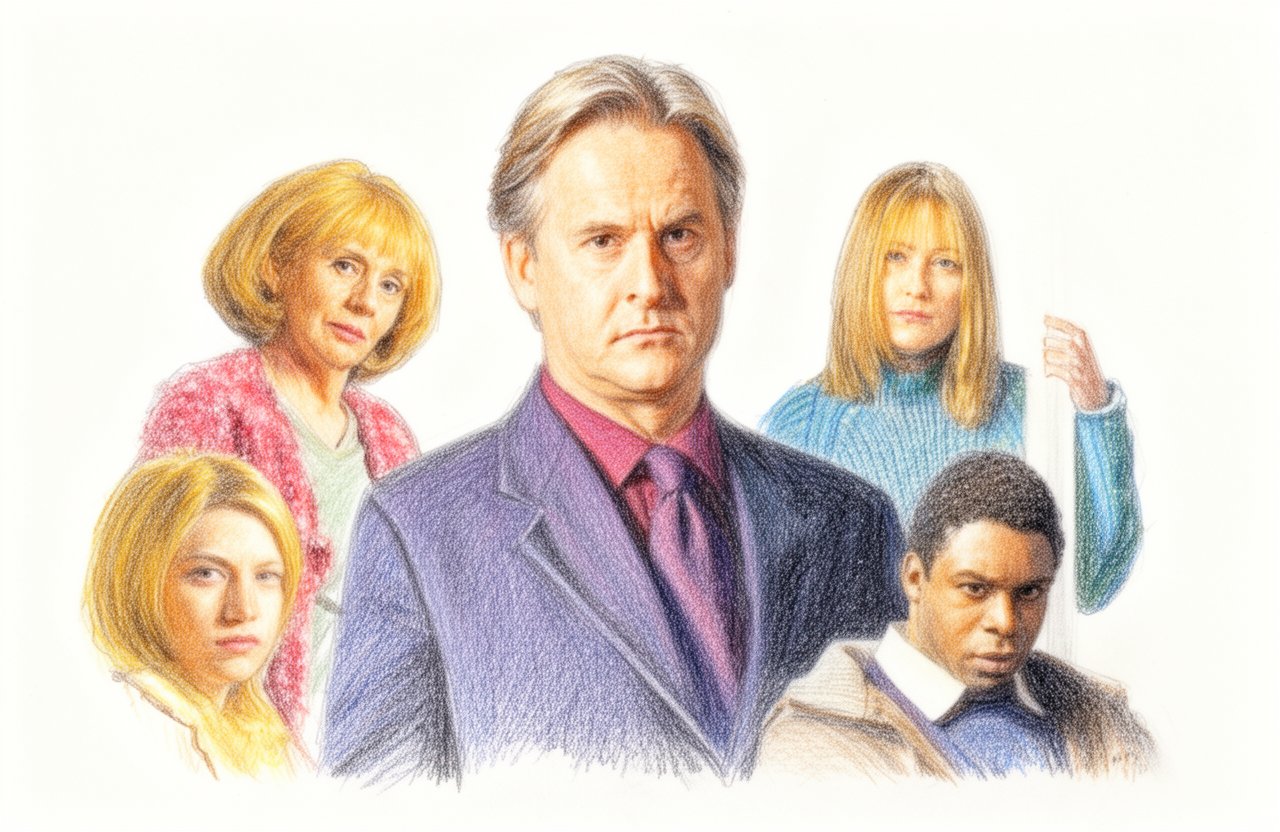
The unit’s dynamic evolved with its personnel. Wil Johnson’s Spencer Jordan provided reliable, street-smart policing, while Claire Goose’s Mel Silver brought youthful tenacity.
The forensic side was anchored first by Holly Aird’s meticulous Frankie Wharton, then by Esther Hall’s Felix Gibson and finally Tara Fitzgerald’s formidable pathologist Eve Lockhart, whose own spin-off, “The Body Farm,” was created.
Félicité Du Jeu’s Stella Goodman and Eva Birthistle’s Sarah Cavendish added further layers as later team members. The series also featured powerhouse guest performances that elevated individual stories.
Harriet Walter, Peter Capaldi, Alison Doody, and Ruth Gemmell delivered memorable turns, with Gemmell’s chilling psychiatrist Linda Cummings creating a recurring nemesis for Boyd.
Paul McGann’s role in the finale as a corrupt senior officer underscored the show’s enduring theme of institutional betrayal. These guest stars often embodied the complex, morally ambiguous antagonists that made the cold cases so compelling to reopen.
Key Episodes & Defining Stories
Pilot: “Waking the Dead” (Alice)
The feature-length pilot is essential viewing, not just as an introduction but as a mission statement. It establishes the entire template: the assembly of the specialist unit, the two-part structure, and the interplay between flashbacks and present-day investigation.
The case—the unsolved murder of teenager Alice Miller—demonstrates how procedural failures can leave killers free to strike again. As Boyd’s reopening of the case provokes the perpetrator into abducting another girl, the stakes are terrifyingly established.
This episode defines the show’s core moral drive and its gritty, serious tone. It proved that a complex, serialised cold case drama could command a primetime BBC One audience, directly leading to the nine-series run that followed.
Cold Fusion (Series 6)
This story represents the series at its most ambitiously cinematic, weaving a cold case into a tapestry of high finance and international intrigue. The discovery of two conjoined skeletons in a derelict bank vault opens a investigation into gold smuggling, corrupt diplomats, and shadowy religious organisations.
Guest stars Peter Capaldi and Alison Doody deliver captivating performances that anchor the complex plot. The episode was so politically charged that the BBC prefaced it with an explicit disclaimer, highlighting the show’s willingness to engage with controversial, real-world power structures.
Fans remember it for its scale and boldness, proving that a cold case could be a gateway into exploring systemic corruption far beyond a simple murder.
Waterloo (Series 9)
The series finale, “Waterloo,” provides a thematically perfect and emotionally resonant conclusion. Boyd, facing the end of his tenure, deliberately reopens his own first major unsolved case: the disappearance of homeless boys near Waterloo Bridge decades earlier.
The investigation becomes a final, brutal confrontation with the police corruption and institutional cover-ups he has battled his entire career, culminating in him being framed for murder. Guest star Paul McGann embodies this corrupt authority as Assistant Chief Commissioner Anthony Nicholson.
It’s a crucial episode because it brings Boyd’s personal and professional journey full circle, offering no easy victories but a stark affirmation of his lifelong, costly pursuit of justice for the voiceless.
The World of Waking the Dead
The series is grounded in a recognisable but specialised version of London. The fictional cold case unit operates from a dedicated headquarters, a hive of activity with its labs and incident rooms, representing a modern, resource-intensive approach to old crimes.
Yet the investigations constantly pull the team out into the city and beyond, from graveyard exhumations to forgotten corners of institutions. The show masterfully uses location to contrast the present with the past.
A modern, gentrified street might be the site of a decades-old murder, with flashbacks peeling away the years. This environmental storytelling reinforces the core premise: the past is not buried; it is merely waiting beneath the surface of the present to be uncovered.
Origin Story
Waking the Dead was created by writer Barbara Machin. A feature-length pilot episode first aired on BBC One on 4 September 2000.
Produced by the BBC Drama Group, with producers like Colin Wratten and executives including Alexei de Keyser and Susan Hogg, the pilot’s strong reception led to a full commission.
The series was distinguished by its two-part story format, with episodes typically broadcast on consecutive nights. This structure allowed for novelistic depth in each case, setting it apart from standard procedural television.
The show’s successful launch paved the way for its eleven-year run, establishing a new benchmark for British crime drama.
Narrative Style & Tone
The show is a serious, character-driven police procedural that blends forensic science with psychological profiling. Its signature narrative device is the use of flashbacks, which visually reconstruct the past events the team is investigating, making the historical crime feel immediate and visceral.
The tone is consistently dark and gritty, dealing unflinchingly with themes like abuse, extremism, and corruption. Interrogation scenes, particularly those led by Boyd, are tense set-pieces of psychological combat.
This mature approach, combined with the two-part format, gave stories room to breathe, allowing for complex plotting and deep exploration of the lasting trauma caused by crime.
How is Waking the Dead remembered?
The series is remembered as a cornerstone of British television crime drama. It achieved significant popular success, with early series regularly drawing over 8 million viewers and maintaining a loyal audience until its finale in 2011.
Its critical reputation was bolstered by awards, including an International Emmy for Best Drama Series in 2004.
Beyond ratings, its legacy lies in its sophisticated format and willingness to tackle difficult social and political issues within a mainstream framework. The show demonstrated that cold cases were not just about forensic puzzles, but about uncovering hidden histories and institutional failures.
Its influence is seen in the dedicated fanbase it cultivated and in the direct spin-off, “The Body Farm,” a testament to the compelling world and characters created by Barbara Machin and her team.
In Closing
Waking the Dead stands as a definitive, intelligent crime series that used the cold case format to explore the enduring shadows of the past with rigour, depth, and compelling humanity.